

What is a grinding machine column?

In this article
The column on the grinding machine is a key component. These machines are among the most widely used in the metalworking industry when it comes to abrasive machining. Why is the grinding machine column so important? How many types of grinding machine are there and what are their parts?
What is grinding?
Among the types of machining that exist, abrasive machining is used to remove small particles of surplus material from a workpiece. This type of work is carried out on machine tools called grinding machines because, as the name indicates, they grind parts to improve their surface finish. To do so, they use an abrasive wheel, made up of bonded grains of a material capable of removing small amounts from the workpiece being machined.
Grinding machines are used to work parts made of metal such as cylinders, gears, etc.; generally small parts that are used as components of other machines and larger parts. For example, a grinding machine is used to work on parts of engines for vehicles and industrial machinery.
Types of grinding machine
There are many types of grinding machine and, depending on the characteristics and operation of each one, different results will be obtained when removing material from and shaping parts to the required specifications.
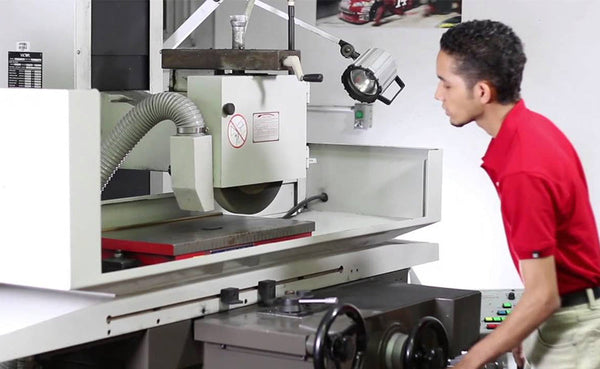
Surface grinding machines
Surface grinding machines are also known as surface grinders and are the easiest to use. These machines have a longitudinal carriage and are in turn divided into face and tangential types. In face grinders the movement is rectilinear, since the spindle, mounted in the grinding column, moves over the workpiece. The tangential grinder, for its part, is characterised by the wheel moving edge-on, since the spindle performs a circular and pendulum movement and the parts are machined from top to bottom.
Cylindrical
These grinding machines are fitted with an axis of rotation that comes from the grinding column. That is why these machines are used for machining cylinders, cones and ellipses. Cylindrical grinders can be external, internal and centreless.
- External: they grind parts on the outer face using a rotary movement in which the workpiece and the wheel turn in the same direction.
- Internal: the machining is done on the inside of the workpiece.
- Centreless: fitted with two wheels that hold the workpiece.
Universal
Universal grinding machines are used for machining workpieces of revolution. These machines are large and are fitted with a longitudinal carriage that allows the parts to move in traversing movements that are simultaneous with the rotary movement. They are suitable for machining large internal and external parts.
Special
The grinding column and the other components of this machine are ideal for machining parts with complex characteristics that cannot be machined with rotary movements. They are used to work milling cutters, profiles, gears, bearings, etc.
CNC grinding machines
The most advanced grinding machines are those that work by computer numerical control (CNC). They have a programming system that is responsible for guiding the machining of the parts. These machines have a unified movement, are automatic and reduce machining times as well as operator intervention.
Parts of the grinding machine
Whatever the type of grinding machine, these machines usually have parts in common. Universal grinding machines, however, need specific parts, as do CNC machines, which have a built-in computer. In addition, some can work with hydraulic mechanisms that require prior knowledge on the part of the operators.
Bed
All machine tools consist of a bed or base, which is what gives the machine stability. The bed must be robust and strong enough to withstand the vibrations caused by machining. The size of the bed varies depending on the type of grinding machine.
Worktable
The table is made of metal and sits on the bed. This is where the heads move in a rectilinear motion to remove the surplus material.
Grinding column
The grinding column is the part that houses the workpiece head, where the spindle and the wheel are mounted. The column sits on the table.
Grinding wheel
The abrasive wheel is the cutting tool of grinding machines. These are fixed on a guide that provides stability. They consist of abrasive grains and a bond. The abrasive wheel moves thanks to a rotary motor that gives the tool its power, as well as the speed needed to shape the workpiece and remove the surplus material.
Workpiece head
The head houses the grinding wheel and the spindle that carries it. It can perform different movements that vary depending on the type of grinding machine used: face, tangential, circular, etc.
Frequently asked questions
What is the column of a grinding machine?
It is the part of the grinding machine that houses the head in which the spindle and the grinding wheel are mounted. It is mounted on the worktable, which in turn rests on the bed. It is a key component: on face surface grinders, the spindle inserted in the column travels over the workpiece, and on cylindrical grinders the axis of rotation comes from the column.
What are the parts of a grinding machine?
The main ones are the bed, the worktable, the column, the head and the grinding wheel. The bed gives stability and absorbs vibration; the metal table sits on the bed; the column, on the table, houses the head with the spindle and the grinding wheel; and the abrasive wheel, made of grains and bonding agent, is the cutting tool and is driven by a rotation motor.
What is the difference between a face surface grinder and a tangential one?
Both are surface grinders with a longitudinal slide. On the face grinder the movement is rectilinear: the spindle, inserted in the column, travels over the workpiece. On the tangential grinder the wheel works on its edge, because the spindle makes a circular, oscillating movement, and the parts are machined from top to bottom. Surface grinders are the easiest to use.
What parts are worked on a grinding machine?
Metal parts, generally small ones, that form part of other machines are ground, such as cylinders, gears or engine components for vehicles and industrial machinery. The abrasive wheel removes small particles of surplus material to improve the surface finish. Special grinding machines also work cutters, profiles, gears and bearings of complex shapes.
Keep reading
Articles →

Looking for machinery for your workshop?
We will advise you with no obligation: a demonstration at our premises, commissioning and our own in-house service and support.