

The surface grinding process

In this article
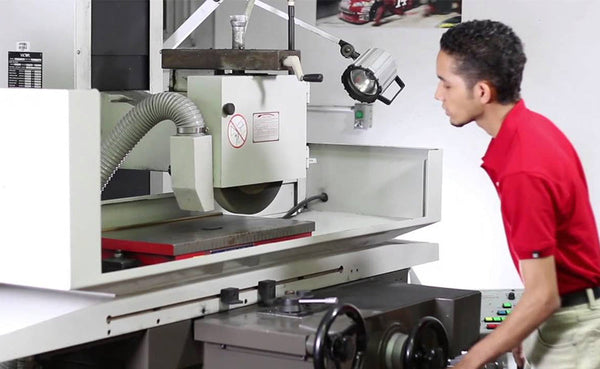
Surface grinding, or horizontal-spindle grinding, is the abrasive process par excellence when geometric accuracy is non-negotiable. It stands as the definitive solution for achieving absolute flatness and minimal roughness, overcoming the finish limitations that milling or turning leave behind because of their cutting forces and vibration.
It is the indispensable technical solution for correcting distortion after heat treatment, making it possible to reach accuracies of just a few microns.
At Heller, as specialists in surface grinders, we know that understanding how this machinery works and its operating procedures is key to maximising the productivity of any machine shop.
What does a surface grinder do?

A surface grinder is a machine tool designed to remove material progressively by means of an abrasive disc called a grinding wheel. Unlike cutting tools with a defined geometry (such as the inserts on a milling cutter), grinding uses microscopic grains that cut away extremely small swarf.
Its main purpose is to correct thermal distortion and irregularities in parts after earlier processes such as forging, casting or heat treatment. This makes it possible to achieve dimensional tolerances in the order of microns, essential for components that must mate with leak-tight fits.
Critical components: the grinding head and the grinding wheel
The heart of the machine is the grinding head, which houses the spindle on which the grinding wheel is mounted. This “tool” is made up of abrasive grains that act as countless cutting edges. Choosing the right wheel (material, grit and bond) will determine whether the result is fast stock removal or a mirror polish.
Operating procedures for precision grinding
To operate a surface grinder successfully and safely, it is essential to follow a rigorous protocol. Here we summarise the essential steps:
Safety inspection and start-up
Before start-up, it is vital to check that the work area is free of obstructions. One step that is often overlooked is balancing the grinding wheel. An unbalanced wheel generates vibration that not only damages the surface finish (chatter marks) but can also cause the disc to burst under centrifugal force, posing a critical risk.
Workholding with the electromagnetic chuck
Most surface grinders use a magnetic chuck to hold the workpiece.
- Procedure: Make sure the base of the workpiece is clean. Once the magnet is activated, check by hand that the workpiece does not move.
- Heller tip: For non-magnetic workpieces, precision vices or dedicated fixtures must be used.
Setting the grinding parameters
The operator must set the depth of pass. We distinguish two stages:
- Rough grinding: Deeper passes to remove volume.
- Fine finishing: Minimum passes to reach the final dimension and the required roughness.
Competitive advantages of surface grinding in industry
Why invest in this process?
- Removal of distortion: After hardening, parts tend to warp. Surface grinding is the only way to restore the original geometry.
- Surface quality: It allows finishes in which friction is reduced to a minimum, ideal for dies, punches and cutting blades.
- Repeatability: In series production, it ensures that all parts are dimensionally identical.
Application sectors: from food to recycling
The use of the surface grinder cuts across modern industry:
- Industrial knives and blades: Manufacture of circular and straight blades for textile or paper cutting processes.
- Automotive and Aerospace: Grinding of cylinder heads, blocks and engine components.
- Moulds and Dies: Fitting of mould plates that require a tight seal.
Maximum performance and structural robustness
Not every machine can offer the rigidity needed for quality grinding. Choosing a machine with stable guideways and a precise hydraulic system will make the difference to your operating costs and to your customers' satisfaction.
At Heller Maquinaria, we have a carefully selected range of surface grinders designed to withstand intensive workloads while maintaining surgical precision.
Frequently asked questions
What is flat surface grinding?
It is an abrasive process, also called tangential grinding, that removes material progressively with a grinding wheel to achieve great flatness and minimal roughness. It surpasses the finish left by milling or turning and allows accuracies of a few microns; that is why it is used when geometric accuracy is essential and to correct distortion after heat treatment.
What is a surface grinder used for?
It is used to correct the thermal distortion and irregularities left by earlier processes such as forging, casting or heat treatment, and to achieve tolerances in the order of microns. After hardening, parts tend to warp, and surface grinding restores their geometry. It also gives minimum-friction finishes and identical parts in series production.
How do you choose the wheel for surface grinding?
The wheel is a disc of abrasive grains that act as countless cutting edges and is mounted on the spindle of the grinding head. Its material, its grain and its bonding agent determine whether the result is fast roughing or a mirror polish. It is advisable to balance it before working: an unbalanced wheel vibrates, marks the surface and may break.
How is the workpiece held on a surface grinder?
Most use an electromagnetic chuck. The base of the workpiece must be clean and, once the magnet is activated, you check by hand that it does not move. For non-magnetic parts, precision vices or specific fixtures are used. The depth of cut is then set: greater in roughing and minimal in finishing.
Keep reading
Articles →

Looking for machinery for your workshop?
We will advise you with no obligation: a demonstration at our premises, commissioning and our own in-house service and support.