

Parts of the Surface Grinder

In this article
The surface grinder is one of the machine tools that machine by abrasion. In this type of machine there is no removal of swarf (or it is minimal) and the tool used is the grinding wheel. The surface grinder is used as a complementary machine to other processes such as turning to give parts a better finish.
What is a surface grinder?
Machining by abrasion is one of the three types of machining used to shape a part by removing material from its surface. Unlike other processes, abrasion involves a minimal removal of material, which is why grinding is considered only a complementary or finishing process for parts.
The parts that are ground are characterised by requiring demanding measurements and tight tolerances with regard to dimensions, geometry or surface finish. The machines used for this procedure are called grinding machines. Today there are different types of grinding machines in industry, the surface grinder being the easiest to use.
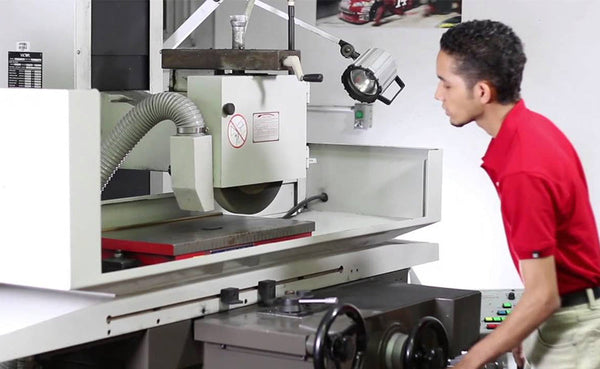
The surface grinder is made up of a longitudinal carriage that allows the translational movement of the workpiece, and of the grinding wheel, which provides the rotary movement. As its name indicates, this type of machine is used for the grinding of flat parts previously machined on other machines such as lathes, milling machines and shaping machines. Surface grinders, in turn, can be divided according to the position of the wheel into face and tangential types.
- Face grinder: the wheel turns on the vertical spindle and machines flat against the workpiece; in addition, the traversing movement is rectilinear.
- Tangential grinder: in this machine the wheel turns on the horizontal spindle and moves over the workpiece with its edge. In tangential grinders the traversing movement is circular and oscillating.
How the surface grinder works
On surface grinders the workpiece is held fixed to the table by means of a magnetic clamping plate. This can be moved manually or mechanically beneath the grinding wheel. In addition, the machine has an internal pump and a series of pipes that allow a coolant suitable for the workpiece and for the grinding wheel to be applied and recirculated.
The principle of operation of these machines is simple. The grinding wheel, mounted on the spindle or head, approaches the surface of the workpiece to be machined. Thanks to the composition of the wheel, and by applying pressure, speed and specific conditions, the abrasion of the excess material on the surface of the workpiece takes place.
Applications
What are surface grinders used for? These machine tools are the most widely used for the machining of specific parts such as bearings, dies, plates, guides, moulds and profiles for tooling. The parts that are ground can range in length from 40 cm to six metres.
Parts of the surface grinder
The face-type surface grinder is made up of a spindle perpendicular to the surface of the workpiece to be ground. This means it requires a series of very specific grinding wheels which remove material from the front of the workpiece. The parts of the grinder are:
- Bed: this part supports the column of the machine.
- Column: this is where the head is supported.
- Head: it can slide on adjustment guideways and this is where the spindle is housed.
- Spindle: the grinding wheel is fitted at its end.
- Grinding wheel: the tool used for grinding. The grinding wheel is made up of grains of quartz, silicon carbide, carborundum or corundum and a binder.
- Cross carriage : it slides on the guideways of the bed and also supports the table.
- Table: this part of the machine moves in a reciprocating manner in the longitudinal direction by means of a hydraulic mechanism.
- Magnetic chuck : the workpieces to be machined are fixed to this part. The chuck is placed on the table.
What movements does the grinder make?
The head of the surface grinder can move manually or automatically. It is manual when it is moved through a wheel-and-worm mechanism. If the movement is automatic, then it is carried out through a wheel. The surface grinder is characterised by the movements it can perform. These are:
- Cutting movement.
- Feed.
- Infeed.
- Transverse movement.
- Tangential speed.
Surface grinders are slow machines. They are not recommended for series production, but they are suitable for parts that require a very precise and meticulous design.
Frequently asked questions
What is a surface grinder?
It is a machine tool that machines by abrasion, with an abrasive wheel and with hardly any swarf, to give the final finish to flat parts already machined on lathes, milling machines or shaping machines. It has a longitudinal slide that moves the workpiece while the wheel provides the rotary movement. It is the type of grinding machine that is easiest to use.
What are the parts of a surface grinder?
The main ones are the bed, which supports the column; the column, which holds the head; the head, which slides on guideways and houses the spindle; the spindle, at the end of which the abrasive wheel is mounted; the cross slide, which slides on the bed and carries the table; the table, with hydraulic longitudinal movement; and the magnetic chuck, on which the workpieces are held.
What is the difference between a face surface grinder and a tangential one?
They are distinguished by the position of the wheel. On the face grinder, the wheel rotates on a vertical spindle, works flat against the workpiece and the movement is rectilinear. On the tangential grinder, the wheel rotates on a horizontal spindle, works on its edge on the workpiece and the movement is circular and oscillating. Both are flat or surface grinders.
What is a surface grinder used for?
It is used to grind parts that require demanding measurements and tolerances in dimensions, geometry or surface finish, such as bearings, dies, plates, guides, moulds and tooling profiles, between 40 cm and six metres in length. It is a slow machine, so it is not recommended for series production, but for parts that call for very precise, meticulous work.
Keep reading
Articles →

Looking for machinery for your workshop?
We will advise you with no obligation: a demonstration at our premises, commissioning and our own in-house service and support.