

How a conventional grinding machine works

In this article
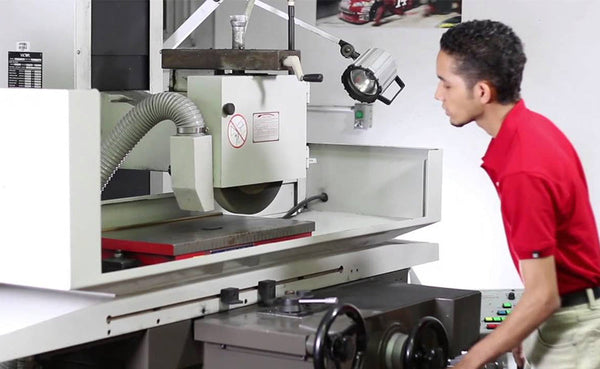
The conventional grinding machine is a machine tool used for the machining of parts by abrasion. Grinding is mostly carried out on steel parts, which are hardened through a heat treatment process.
What is a conventional grinding machine?
In the machining field there are three procedures by which parts can be worked: with swarf removal, without swarf removal and by abrasion. The abrasion process is carried out using a machine tool called a grinding machine and is characterised by working parts with great dimensional accuracy and less roughness.
To grind a material, grinding wheels, which are sturdy abrasive discs, are used. But when is grinding done? It is generally used as a complementary method once the part has been worked on other machines such as the lathe, milling machine and so on. Other machining processes, such as turning or milling, remove large amounts of material; the remainder can be removed by abrasive processes to perfect the part. Grinding also allows these parts to be treated by other methods such as polishing and lapping.
Conventional grinding machines consist of a frame to which the rotating grinding wheel is attached; the wheel is made up of very tough, hard abrasive grains. The speed of these wheels can reach 30,000 revolutions per minute. It all depends on the diameter of the wheel.
Types of grinding machine
It is important to note that there are different types of grinding machine on the market and that they are used according to the type of parts to be machined and the use made of them in workshops:
- Surface grinding machine: this type of grinding machine can be divided into two: tangential and face. They stand out because they are easy to use, since they are fitted with only a slide that allows the rotation and traverse movements of the part.
- Centreless: for grinding small cylindrical parts. They can be automated.
- Conventional or universal grinding machine: mostly used for machining the outside diameters of shafts. These are large machines and are characterised by a wheelhead fitted with a variable-speed drive that is adjusted according to the characteristics of the wheel and the part to be ground.
- Cylindrical grinding machine: divided into external and internal.
How does the conventional grinding machine work?
The universal or conventional grinding machine has the advantage of offering much greater working capacity, since it allows parts to be ground as they revolve. These machines are characterised by their large size and sturdiness, which allows all kinds of parts to be machined, almost regardless of their dimensions. On a conventional grinding machine you can work minute parts that require great accuracy, but it also allows much larger parts to be machined.
This machine has a longitudinal slide that provides the traverse movement to the parts, which rotate about their own axis, through the automatic advance and return of the slide itself. The movement of the slide is achieved by a hydraulic mechanism.
The grinding wheels, for their part, rotate in the opposite direction to the part being machined. And what is the rotation speed of the spindle? It must be adjusted according to the hardness of the part and the characteristics of the machining; for this purpose, the conventional grinding machine has speed regulators.
Grinding wheels on grinding machines
The grinding wheels or abrasive brushes are the fundamental tool on every grinding machine. These wheels adapt to the shapes of the parts and provide a cushioning action that is ideal for all kinds of surfaces to be ground. They can easily adapt to the complex contours and shapes of parts and are designed to provide a uniform finish.
On grinding machines, the wheel rotates at high speed to remove high spots, imperfections and irregularities from the parts being machined. These wheels are made of a composite material: backing material, bonding agent or resin, and abrasive mineral. Wheels are characterised by their hardness and structure, as well as by the type of mineral they use; these are factors to take into account before choosing a grinding wheel. It also depends on the degree of finish you want to achieve on the part and on its properties.
Among the properties of grinding wheels, we find that they have an undefined number of cutting edges formed by the abrasive grains; these abrasive grains, which are held together by the bonding agent, are what work the part when they come into contact with the surface. In addition, these tools have cutting points positioned at random, so it is difficult to control the position of each of the grains in the wheel.
Finally, we should point out that the grinding process consumes large amounts of energy; 80% of this energy is lost as heat, while 10% of it is consumed directly by the grinding wheel.
Frequently asked questions
What is a conventional grinding machine?
It is a machine tool that machines parts by abrasion with a rotating wheel of very hard abrasive grains, and that achieves high dimensional accuracy and lower roughness. It is used above all with steel parts hardened by heat treatment. It is also called a universal grinder and is used mainly to grind the outside diameters of shafts.
At what point in the process is a workpiece ground?
Normally at the end, as a complementary method, after working the workpiece on other machines such as the lathe or the milling machine. Turning and milling remove large amounts of material, and grinding takes off the surplus to perfect the workpiece. Afterwards, the workpiece can go through other processes such as polishing and lapping.
How does a conventional grinding machine work?
A longitudinal carriage, moved by a hydraulic mechanism, moves the workpiece with automatic feed and return while it rotates about its own axis. The wheel rotates in the opposite direction to the workpiece and removes high spots, imperfections and irregularities. The speed is adjusted with regulators according to the hardness of the workpiece and the characteristics of the machining.
How is the grinding wheel of a grinding machine chosen?
You need to take into account its hardness, its structure and the type of abrasive mineral, as well as the degree of finish you want to achieve and the properties of the workpiece. Wheels are made of a composite material: backing material, a binder or resin, and abrasive mineral. Their speed can reach 30,000 revolutions per minute, depending on the diameter.
Keep reading
Articles →

Looking for machinery for your workshop?
We will advise you with no obligation: a demonstration at our premises, commissioning and our own in-house service and support.