

What Is a Universal Grinder?

In this article
For machining by abrasion, that is, without swarf removal, a grinding machine is used. Among the different types of grinding machines that exist, the universal grinder is one of the most widely used in machine shops, thanks to the many benefits it offers.
What is a universal grinder?
Machining of parts can be done with swarf removal, without swarf removal and by abrasion. Machining by abrasion removes material from a part to shape it, but it removes the material in small quantities; grinding is a process for improving the finish of parts and can be used after the part has been through other machines such as lathes, milling machines, etc.
The grinding machine uses a tool called an abrasive wheel, which is made up of grains of silicon carbide, quartz and corundum, as well as a binder. Grinding makes it possible to refine parts that need tight tolerances and exacting measurements in terms of size, geometry or surface finish. Thus, a grinding machine can improve the diameter, length and angle of the part; its concentricity and parallelism, but also the roughness and the direction of the grinding marks.
The parts used in the grinding machine are mostly made of steel hardened by heat treatment.
Types of grinding machine
Grinding machines are classified, according to the parts to be ground, into:
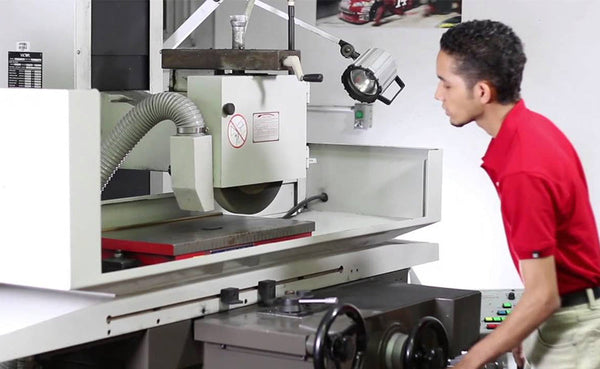
- Surface or tangential grinders: made up of a head (this is where the grinding wheel is located), as well as a longitudinal carriage. The part to be ground is placed on this carriage. It is used to grind dies and flat surfaces.
- Centreless: this grinding machine is used for grinding small cylindrical parts. It allows machining in series.
- Universal grinder: used for grinding the outside diameters of shafts. These are large machines, with a grinding wheel head with variable speed drive.
Features and parts of the universal grinder
The universal grinder has the quality of offering a greater working capacity, since the machining is of bodies of revolution. Universal grinders are robust and of great size, so it is possible to machine the insides and outsides of various parts; some of these parts have, for example, a cylindrical shape or a conical one. In other words, this machine can work surfaces with curved or straight generatrices, as well as flat surfaces that are perpendicular to the axis of the part. What is a universal grinder made up of?
Bed
The bed supports the machine and guides its different parts so that they can do their work. On the long side, precision-machined guideways are installed, in three different forms: prismatic, flat and V. In addition, parallel to these there are two cross guideways that allow the carriage to slide.
Outside the bed are the hydraulic power unit, the coolant system and the machine's electrical cabinet.
Universal grinder table
The table is divided into two parts. In the lower part are the guideways; these are positioned so that they match those of the bed. The upper part of this table can swivel on the horizontal plane and on it are the workhead and the tailstock. The table makes a reciprocating movement along the guideways of the bed or base.
Workhead
This is located at one end of the table and is responsible for rotating the parts needed for machining. It consists of two parts: a table or platform that slides on the table and the head itself. The head, in turn, is divided into two parts: main spindle and motor.
Wheelhead
It sits on two cross guideways. The lower part moves on the bed; on top of it, in turn, sits the upper part, which can be swivelled and is used for grinding tapered parts. In addition, the spindle is the part of the head where the grinding wheel is installed at one end, while at the other end the drive pulley is attached. This pulley, in turn, is attached to a motor.
The cylindrical grinder can be converted into a universal grinder when the spindle with a wheel collet is fitted at the rear of the wheelhead.
Tailstock
Also called the footstock, it is a block made up of guides that fit onto the table. This allows it to be positioned wherever desired. The tailstock is fixed to the table by means of screws that work by pressure. The tailstock spindle has the feature of being able to retract immediately by means of a lever.
Grinding wheel
The grinding wheel is provided with a rotary movement opposite to that of the workpiece. The wheel has a series of abrasive grains, hard and wear-resistant, and can reach rotation speeds of up to 30,000 revolutions per minute. The wheel must be chosen according to the material of the workpiece to be ground, as well as the shape to be given to that workpiece.
Frequently asked questions
What is a universal grinder?
It is a robust, large grinding machine for parts of revolution that can grind both exteriors and interiors: cylindrical and tapered surfaces, with straight or curved generatrices, and flat faces perpendicular to the axis of the workpiece. It is usually used after the lathe or the milling machine to improve the finish and achieve demanding tolerances, above all on parts made of steel hardened by heat treatment.
What is the difference between a universal grinder, a surface grinder and a centreless grinder?
The surface or tangential grinder carries the wheel on a head and the workpiece on a longitudinal slide, and is used for dies and flat surfaces. The centreless grinder grinds small cylindrical parts and allows series production. The universal grinder grinds external diameters of shafts and internal ones; it is larger and its wheelhead has a variable speed drive.
What are the parts of a universal grinder?
It has a bed with prismatic, flat and V-shaped ways; a two-part table, whose upper part swivels in the horizontal plane and moves back and forth; the workhead, which rotates the workpiece; the wheelhead, which can be swivelled to grind tapers; the tailstock; and the grinding wheel. Outside the bed are the hydraulic power unit, the coolant system and the electrical cabinet.
What are the characteristics of the grinding wheel of a universal grinder?
It is made of hard, wear-resistant abrasive grains, such as silicon carbide, quartz or corundum, held together by a bonding agent. It rotates in the opposite direction to the workpiece and can reach up to 30,000 revolutions per minute. It is chosen according to the material of the workpiece and the shape to be produced, and it makes it possible to improve diameter, concentricity, parallelism and roughness.
Keep reading
Articles →

Looking for machinery for your workshop?
We will advise you with no obligation: a demonstration at our premises, commissioning and our own in-house service and support.