

Vertical milling machine: parts and features

In this article
The vertical milling machine is one of the most widely used conventional machine tools in the machining industry. The vertical milling machine and its parts, as well as their proper operation, are vitally important so that the work carried out on the machine is of great precision.
What is a vertical milling machine?
The milling machine is a machine tool that uses a single- or multi-edged tool called a milling cutter. The cutter rotates on its own axis at high speed to remove swarf when it comes into contact with the surface of the workpiece to be machined.
In the machining industry there are different types of milling machine that can be classified according to the orientation of the tool, the number of axes, or as special ones, because they are used to machine very specific parts. Within the classification of milling machines by tool orientation are the vertical milling machines. What is a vertical milling machine and what are its parts?
The vertical milling machine is a type of machine tool fitted with a spindle that is positioned vertically and is used to hold and rotate the cutting tool against the surface of the workpiece. It moves along the Z axis, that is, in an upward and downward movement; at the same time, it exerts pressure on the workpiece to remove material.
Vertical milling machines are machines used to machine large workpieces or single-face parts.
Types of vertical milling machine
Vertical milling machines are in turn subdivided into fixed-bed and turret types.
- Fixed-bed vertical milling machine. The head has no movement other than that of the cutting tool. In this type of vertical milling machine it is the table that performs the movements.
- Vertical turret. This machine tool has a head that is able to perform horizontal movements of 180 degrees about the horizontal axis of the workpiece.
What is the vertical milling machine used for?
Vertical milling machines are very versatile machine tools used to carry out different types of machining. With a vertical milling machine it is possible to rough parts, drill and remove surplus material from a part to shape it. This machine tool also has the ability to produce any design, provided the necessary cutting tools are used.
Today it is possible to find vertical milling machines that operate by computer numerical control, or CNC. This technology makes it possible to machine very complex, small parts with tight tolerances. With a CNC vertical milling machine, machining procedures are automated and production costs are reduced. In addition, the results of the work are of great accuracy and quality.
Because of these features, vertical milling machines offer great advantages to the workshops that use them. They are easy to use and do not need an experienced operator to run them. When a CNC vertical milling machine is used, a single operator can work on several machines that include this technology at the same time.
Vertical milling machine: the most important parts
As you have already seen, there are two different types of vertical milling machine: fixed-bed and turret. Although these are machines with very specific characteristics, these types of vertical milling machine have fairly similar parts.
Worktable
The worktable is an essential part of all machine tools. On the worktable, in the case of the vertical milling machine, rests the workpiece to be machined. Many worktables include guides that make machining easier. On this machine tool the worktable moves from top to bottom and vice versa.
Head
The head of the vertical milling machine is made up of two parts. One is the tool-holder arm, which is joined to the other part of the head by a circular slide set at an angle of 45 degrees; the second is joined by a vertical slide to the front of the machine column. The main spindle of the machine is fitted here.
On this machine, the head can hold milling cutters, drill bits and the other cutting tools that the milling machine accepts. These tools are fitted by means of collets, drill chucks and other clamping elements.
Motor
The milling machine needs a motor so that the cutting tool and the other parts can work. On vertical milling machines, the motor usually works through a belt transmission system that turns a pin.
Handle
The vertical milling machine is made up of a series of crank handles that are used to move the different parts of the machine. In general, the main crank handle is used to raise and lower the cutter via the spindle. Other types of handle fitted to vertical milling machines are:
- Vertical. Moves up and down along the Z axis.
- Longitudinal. Moves the worktable along the X axis.
- Transverse. Moves the worktable along the Y axis.
- Head handle. Moves the spindle.
Frequently asked questions
What is a vertical milling machine?
It is a milling machine with the spindle positioned vertically, which holds and turns the cutter against the surface of the workpiece to remove swarf. It belongs to the classification of milling machines by tool orientation and is one of the most widely used conventional machines in machining. It is used to machine large workpieces or workpieces worked on a single face.
What are the parts of a vertical milling machine?
The main ones are the worktable, on which the workpiece rests; the head, where the main spindle is fitted and cutters and drill bits are mounted with collets or drill chucks; the motor, which usually transmits the rotation by belt; and the handwheels, which raise and lower the cutter, move the table on the X and Y axes, give the vertical movement on Z and move the spindle.
What is the difference between a bed-type vertical milling machine and a turret-type one?
On the bed-type, the head has no movement other than that of the cutting tool and it is the table that makes the movements. On the turret type, the head can also make horizontal movements of 180 degrees about the horizontal axis of the workpiece. Even so, the two share very similar parts: table, head, motor and handwheels.
What is the head of a vertical milling machine like?
It consists of two parts. The tool-holding arm is joined to the other part by a circular slide with a 45-degree inclination, and this part is joined to the front of the column by a vertical slide. The main spindle is fitted in the head, and cutters, drill bits and other tools are mounted using collets, drill chucks and other clamping elements.
Keep reading
Articles →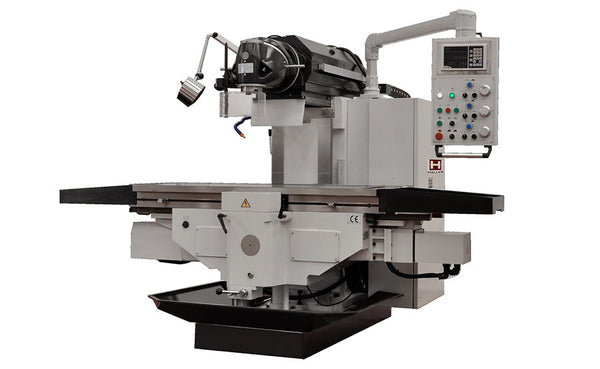


Looking for machinery for your workshop?
We will advise you with no obligation: a demonstration at our premises, commissioning and our own in-house service and support.