

Applications of the universal milling machine in the automotive industry

In this article
The automotive industry is one of the most demanding sectors in terms of the precision, repeatability and reliability of the components it manufactures. That is why versatile, robust machinery is essential to guarantee the quality of every vehicle that leaves the factory. In this context, the universal milling machine is a key tool, used in production as well as in maintenance and prototyping.
At Heller Maquinaria, as specialists in solutions for the industrial sector, we know first-hand the essential role that universal milling machines play in automotive manufacturing.
Why is the universal milling machine used in the automotive industry?
The universal milling machine stands out for its ability to carry out many machining operations on a single machine: milling of flat surfaces, creating cavities, machining gears and keyways, angled cuts and more. This allows more efficient, accurate production, meeting the demanding quality standards of the automotive sector.
Main applications in the automotive sector
1. Machining engine blocks and cylinder heads
Universal milling machines can carry out face milling of the mating surfaces, machining of the cylinder seats and the housings for fasteners and internal components. These operations are critical to guarantee the sealing and thermal performance of the engine. Thanks to its rigidity and accuracy, the milling machine is able to hold tolerances of microns in materials such as grey cast iron or high-density aluminium.
2. Manufacturing transmission and differential components
It is used to produce spur and helical gears, splined shafts, pinions and gearboxes. The rotary table combined with accessories such as the dividing head allows highly accurate indexed machining. It is also commonly used to create housings and mating faces on transmission casings, which must fit together perfectly to prevent lubricant leaks and ensure smooth meshing.
3. Production and adjustment of moulds and assembly tooling
In the manufacture of plastic injection moulds (bumpers, interior panels, lighting elements), the milling machine is used to shape the mould cavities and cores, as well as to create cooling channels and perfectly flat closing surfaces. It is also used to make positioning fixtures, inspection gauges and assembly jigs used on the assembly line.
4. Prototyping functional parts
During the development of new models, it is necessary to create initial versions of metal parts, such as brackets, fixings, covers or housings. The universal milling machine is ideal for this work, since it allows designs to be modified quickly without depending on specific tooling. It can also work with different types of material, from aluminium to special steels, which is essential in strength testing and component validation.
5. Corrective maintenance on the production floor
Universal milling machines are also essential in the industrial maintenance workshops of car factories. They are used to recondition damaged shafts, resurface machine beds, re-machine worn housings, or adjust spare parts that do not fit perfectly. Their versatility reduces downtime and avoids having to replace entire machines because of minor faults.
Advantages of the universal milling machine in the automotive industry
- High dimensional accuracy
The universal milling machine can hold tight tolerances, which are essential in the manufacture of critical parts such as engine blocks, gears or transmission housings. This guarantees correct assembly, lower friction and a longer vehicle life.
- Machining versatility
Thanks to its design, the universal milling machine can work on parts from different angles (horizontal, vertical or inclined), make straight cuts, keyways, slots and cavities, and combine different types of machining in a single set-up. This saves time and improves productivity on the shop floor.
- Adaptability to different materials
It can work on anything from soft materials such as aluminium or engineering plastics to alloy steels and cast iron. This capability makes it an indispensable tool for prototypes as well as for final parts or spares.
- Lower costs and shorter production times
By centralising several operations in a single machine, changeover times between machining centres are eliminated, material waste is reduced and human error is minimised. This translates directly into greater operational efficiency.
- Ideal for maintenance and in-house manufacturing
In many automotive plants, the milling machine becomes a strategic ally for in-house manufacture of tooling, emergency adjustments or the repair of specific parts, without having to subcontract or wait for spares.
- Compatibility with multiple accessories
It can take special heads, dividing heads, rotary tables, stops and other attachments that widen the range of work possible, making it even more versatile in the production environment.
At Heller Maquinaria we have the ideal milling machine for your automotive plant
At Heller Maquinaria we have a wide stock of new and used universal milling machines, fully inspected and ready to be integrated into any production plant in the automotive sector. We help you find the most suitable solution according to your workload and type of part.
👉 See our available milling machines
📩 Contact our technical team and we will advise you with no obligation.
Frequently asked questions
Why is the universal milling machine used in the automotive industry?
Because it allows multiple machining operations to be carried out on a single machine: milling of flat surfaces, cavities, gears, keyways and angled cuts. This makes production more efficient and accurate and meets the demanding quality standards of the automotive industry, a sector that demands accuracy, repeatability and reliability in every component.
Which automotive parts are machined on a universal milling machine?
It is used on engine blocks and cylinder heads (face milling of mating surfaces and cylinder seats) and on transmission and differential components: spur and helical gears, splined shafts, pinions and gearboxes. It is also suitable for plastic injection moulds, assembly fixtures and prototypes of brackets, fixings, covers or housings.
What is the universal milling machine used for in the maintenance of an automotive plant?
In industrial maintenance workshops it is used to recover damaged shafts, face machine beds, restore worn housings or adapt spare parts that do not fit. This reduces downtime and avoids replacing entire machines because of minor faults, without having to subcontract the work or wait for spare parts.
Which materials does a universal milling machine work in automotive applications?
It handles everything from soft materials such as aluminium or engineering plastics to alloy steels, special steels and cast irons. That is why it suits prototypes as well as final parts and spares. Thanks to its rigidity and accuracy, it can hold micron-level tolerances in materials such as grey cast iron or high-density aluminium.
Keep reading
Articles →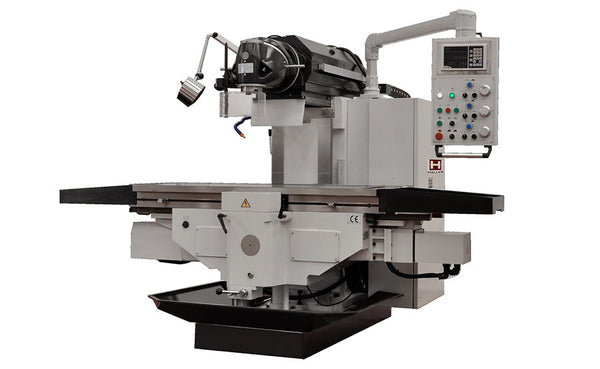


Looking for machinery for your workshop?
We will advise you with no obligation: a demonstration at our premises, commissioning and our own in-house service and support.