

Universal milling machine head

In this article
The head of the universal milling machine is one of the most important parts of this machine tool, as it houses the cutting tool or milling cutter. What should this head be like? What technical specifications must it meet?
What is the universal milling machine?
The universal milling machine belongs to the group of milling machines that are classified according to the position of the head and the corresponding cutting tool relative to the workpiece. You should know that milling machines, whatever their type, have a fixed head that houses the milling cutter. In the head of the universal milling machine, only the cutter moves, rotating on its own axis to machine the workpiece.
But before looking in detail at the head of the universal milling machine, it is important to make clear that the operating principle of these machines is similar. Milling machines carry out machining by metal cutting (removal of the surplus material from the surface of the workpiece). This removal of material is made possible by the rotary movement of the cutting tool or milling cutter. Milling cutters are distinctive in having one or more cutting edges that remove the material when they reach the surface of the workpiece.
Milling machines can carry out many machining operations, such as roughing and drilling; they can work parts of different characteristics and materials. This makes them very versatile machine tools. On a universal milling machine, for example, it is possible to work wood, steel, cast iron, synthetic materials such as plastic and non-ferrous metals; curved, flat, toothed parts and so on can also be machined.
Universal milling machines: a hybrid between horizontal and vertical
We have already mentioned that universal milling machines, like horizontal and vertical milling machines, belong to the group of milling machines classified by the orientation of the cutting tool. What is the difference between these three types of milling machine?
Horizontal milling machines use cylindrical cutters that are mounted on the horizontal arbor, which is driven in the head of the machine itself. This type of milling machine is also called ram-type, the ram being a sliding bridge of the machine. Vertical milling machines, for their part, are fitted with a spindle that is oriented vertically and perpendicular to the machine table; this allows a greater depth of cut or pass.
However, universal milling machines are a mix of the horizontal and vertical types. These machines have a vertical spindle to which the horizontal tool arbor can be coupled; but they also have a head that attaches to this spindle and makes it possible for the milling machine to be converted to a vertical one. Universal milling machines also have a ram that moves forwards and backwards on a pair of guideways.
What is the head of the universal milling machine like?
Universal milling machines are distinctive in that they do not have a single head but can take different types: universal dividing, Huré, Gambin, vertical, orthogonal and slotting. Which is the best? How do you choose between them?
Universal dividing head
This universal milling machine head has a circular rotary plate that allows the head itself to rotate in the vertical plane. It is mounted on a base fixed to the bed of the machine tool. It also includes a graduated scale through which the degrees of rotation of the head can be set. In addition, the head is swivelling and, thanks to this feature, it can tilt or move the spindle to any angle.
Huré milling machine head
This type of head offers great performance for the machine tool. It has the advantage that it can be used for the different types of milling that can be carried out: horizontal, radial, vertical, angular and oblique. This head can easily be adapted to universal milling machines and consists of three parts.
The parts of the Huré head are the body, which is fixed to the frame; an intermediate body, which is the one that rotates on the platform and has a second platform that allows rotations and tilts at 45 degrees; and the cutter-holder body. This is the part where the main spindle is held. Thanks to its design, the Huré head accepts the coupling of the various cutting tools that milling machines can use, such as drill bits. This can be done with the help of collets and drill chucks.
Gambin head
This is a type of head for universal milling machines that is less sturdy than the rest, but much easier to orient. Thanks to this feature, parts can be worked more easily. This is possible because the rotation axes of the Gambin head are octagonal.
Vertical head
The vertical head has no rotary base and can only move on the Z axis; this limits its use to milling machines fitted with swivelling tables. It has cutter holders and an intermediate shaft that provide rotation.
Orthogonal head
This type of head has a body that can tilt through 90 degrees with respect to the X and Z axes of the machine. Because of this quality, milling machines fitted with this head can machine parts even at inclined angles.
Slotting head
This type of head is ideal for slotting and planing parts, but it is also one of the most powerful when it comes to metal cutting. It has two movements: one for cutting and one for depth.
Frequently asked questions
What is the function of the head of a universal milling machine?
The head is one of the most important parts of the universal milling machine, because it houses the cutting tool or cutter. Only the cutter moves in it, rotating on its own axis to machine the workpiece. The universal milling machine does not have a single head: different types can be fitted, depending on the job to be done.
What types of head can be fitted to a universal milling machine?
A universal milling machine can take six types of head: universal dividing, Huré, Gambin, vertical, orthogonal and slotting. Each provides different movements: the dividing head swivels in the vertical plane with a graduated scale, the Huré allows horizontal, radial, vertical, angular and oblique machining, and the orthogonal head tilts 90 degrees relative to the X and Z axes.
What is the difference between the Huré head and the Gambin head?
The Huré head offers high performance: it is suitable for horizontal, radial, vertical, angular and oblique machining, it is made up of three sections and it allows rotation and tilting at 45 degrees. The Gambin is less sturdy than the others, but much easier to orient thanks to its octagonal swivel axes, which makes the workpieces easier to work on.
What is the slotting head of a milling machine used for?
The slotting head is ideal for slotting and planing workpieces, and it is one of the most powerful for metal cutting. It has two movements: one for cutting and one for depth. It is one of the six types of head that can be fitted to a universal milling machine.
Keep reading
Articles →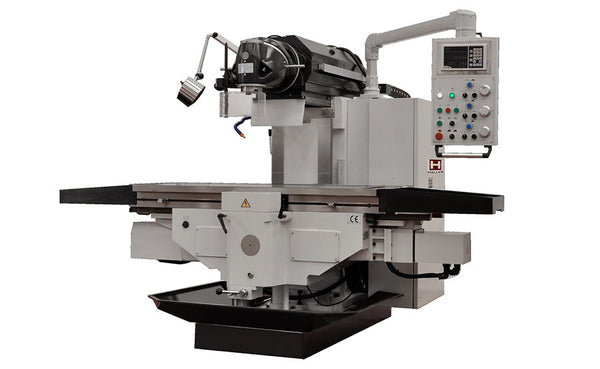


Looking for machinery for your workshop?
We will advise you with no obligation: a demonstration at our premises, commissioning and our own in-house service and support.