

Universal milling machine: everything you need to know

In this article
The milling machine is a machine tool widely used in machining workshops to shape workpieces made of different materials, such as steel, cast iron, metals and synthetic materials, among others. The universal milling machine is one of the types of milling machine you can find in the metalworking industry.
What is a universal milling machine?
The milling machine is a machine tool that makes it possible to machine workpieces by swarf removal; this work is carried out by a rotary tool with several cutting edges that is called a milling cutter. With this machine it is possible to work different materials such as wood or steel, but also synthetic materials and cast iron.
In addition, the milling machine has the ability to work flat, curved and slotted surfaces, etc. Workpieces that go through a milling machine can be roughed out or finished, after having been machined on this machine.
A conventional milling machine is characterised by the fact that the workpiece to be machined moves, bringing the areas to be worked towards the milling cutter. In this way, flat or complex surfaces are obtained.
You should know that milling machines were invented in the 19th century and soon became indispensable machines in workshops. Over the years and thanks to the emergence of new technologies, milling machines have managed to evolve and remain one of the most important machine tools for machining.
Milling machines are characterised by being versatile, since many machining tasks can be carried out on them. And, as it is a machine that has evolved considerably, it is important that it is operated by qualified personnel: a milling machine operator, setter or programmer.
Types of milling machines
There is a fairly broad classification that attempts to highlight the types of milling machines that exist today. They are classified according to many aspects, such as the number of axes or the orientation of the axis of rotation. In this article we are going to focus on the type of milling machine according to the orientation of the tool:
- Horizontal milling machine: this type of machine is characterised by using cylindrical milling cutters mounted on a horizontal arbor that is driven by the machine's head. This type of milling machine is used mainly for slot milling.
- Vertical milling machine: so called because the spindle axis is oriented vertically and perpendicular to the worktable. The milling cutters are fitted in the spindle and rotate about their axis. Among vertical milling machines we find bed-type machines and turret or knee-type machines.

- Universal milling machine: with a somewhat limited scope of application because of the cost and size of the workpieces that can be machined.

What is a universal milling machine?
The universal milling machine, also called a universal horizontal milling machine, has a main spindle that is used for coupling toolholder arbors, as well as a head that is attached to the spindle and turns the traditional milling machine into a vertical one. This type of machine tool has somewhat limited use because of the cost of the equipment and the workpieces that can be machined on it.
On this type of machine tool, the ram or sliding bridge has a movement that allows it to move from front to back and vice versa along guideways. In addition, this milling machine differs from the traditional horizontal one because the table can move through an angle of up to 45 degrees and give the workpiece to be machined a certain inclination. 
Operation of the universal milling machine
The universal milling machine works thanks to the milling cutter, the cutting tool that rotates at high speed and removes swarf from the surface of a material. This process is possible on this type of machine thanks to the action of a person who moves the milling cutter and the workpiece to achieve the machining.
The universal milling machine stands out for having a vertical head called a Huré head, which serves to increase the performance of the machine. This mechanism is applied only to universal milling machines and for milling at different angles. For example, vertical plane perpendicular to the milling table or radial, etc.

This machine tool has a very basic mode of operation. After switching on the machine, the workpiece to be machined must be placed in the machine's clamping device and the column of the milling machine must be positioned. Then the milling cutter best suited to the job is fitted in the spindle. After that, all that remains is to move the machine's levers to shape the workpiece.
Types of jobs
On a universal milling machine many jobs can be carried out to machine workpieces. Among the most important are:
| Slot milling | Slot milling can be straight, form or keyway milling. Each of these processes has its own characteristics. In straight slot milling, cylindrical milling cutters are used; in form slot milling, the cutter may have the shape of the slot, such as T-slot, dovetail, etc. |
| Copying | With milling cutters fitted with round-profile inserts. |
| Gear milling | This machine is rarely used for this type of work, but it is done using a dividing head. |
| Slotting | Used for machining keyways in holes. For this, a special tool is used that is fitted to the head of the machine and serves to convert the movement. |
Frequently asked questions
What is a universal milling machine?
It is a milling machine, also called a universal horizontal, with a main spindle for fitting arbors and a head that attaches to the spindle and turns it into a vertical machine. Unlike the traditional horizontal, its table can swivel up to 45 degrees to tilt the workpiece, and its ram moves back and forth on ways.
What is the difference between a horizontal, a vertical and a universal milling machine?
The horizontal uses cylindrical cutters mounted on a horizontal arbor and is used mainly for slotting. On the vertical, the spindle axis is vertical and perpendicular to the table. The universal combines both: it works horizontally and, with a head attached to the spindle, vertically; in addition, its table can tilt up to 45 degrees.
What jobs can be done on a universal milling machine?
The main ones are straight, form and keyway slotting; copying, with round-profile insert cutters; gear milling, which is unusual, with a dividing head; and slotting of keyways in holes, with a special tool attached to the head. With the Huré head, it is also possible to mill at different angles.
How do you work with a universal milling machine?
After switching on the machine, the workpiece is placed in the clamping and the column is adjusted. Then the cutter best suited to the job is mounted on the spindle and the levers are moved to shape the workpiece. It is a manually operated machine: the operator moves the cutter and the workpiece, so it should be used by qualified personnel.
Keep reading
Articles →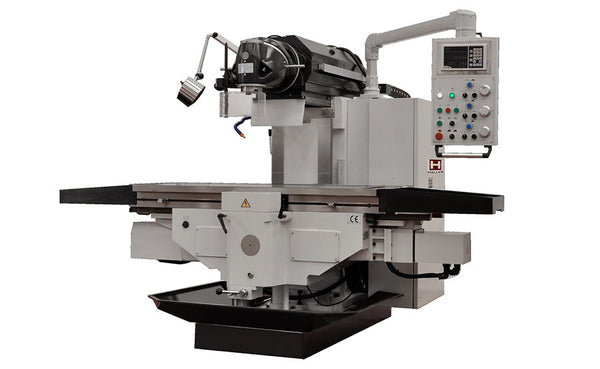


Looking for machinery for your workshop?
We will advise you with no obligation: a demonstration at our premises, commissioning and our own in-house service and support.