

The importance of the grinding wheel in a cylindrical grinding machine

In this article
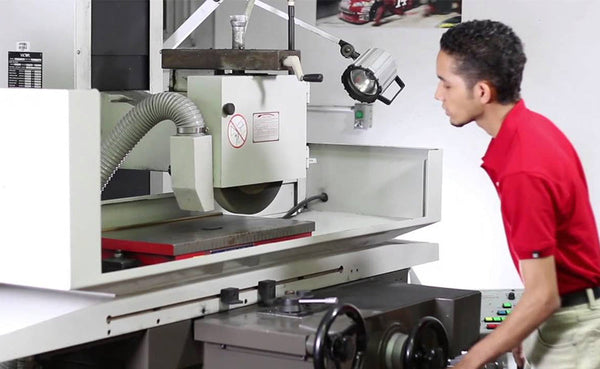
The cylindrical grinding machine is a machine tool used for machining by abrasion; that is, by wearing down the surface of the workpiece using abrasive substances and elements. One of the tools that allow workpieces to be machined by this method is the grinding wheel fitted to cylindrical grinding machines.
Machining on a cylindrical grinding machine
Cylindrical grinding machines carry out machining by abrasion on workpieces with very specific dimensions and tolerances. Grinding is a process carried out after other machining operations such as turning, milling or drilling. Grinding is a process that completes the design of a workpiece; this work gives the workpiece its final finish.
Grinding requires specific machines equipped with the tools needed for this abrasive procedure. That is why a cylindrical grinding machine consists of, among other parts, a solidly built bed fitted with two heads mounted on carriages.
On one side is the carriage for the grinding wheel or abrasive wheel, which is usually fixed, and on the other the carriage for the regulating wheel, which is generally tilting.
Types of cylindrical grinding machine
These machines, which can work in different ways, are divided into three:
- External: used for grinding the external surfaces of workpieces between centres. The workpiece can rotate and the grinding wheel turns in the same direction as the workpiece when it comes into contact with it.
- Internal: on these machines grinding is done on the inside of the workpiece. The grinding wheel is smaller than the width of the workpiece, which is held by a magnetic ring that stops it from moving.
- Centreless: for grinding small workpieces. This type of cylindrical grinding machine has two wheels that turn in the same direction; in the space between them a workpiece is placed that turns in the opposite direction to the wheels.
What is a grinding wheel?
The wheel is a fundamental part of the cylindrical grinding machine, since it is an abrasive tool that removes tiny particles of swarf in machining with abrasives. These processes use very hard materials that can remove small amounts of swarf, which makes it possible to work complex workpieces of small dimensions.
Machining by abrasion is used on hard, complex materials that are difficult to remove by other methods such as turning or milling.
Characteristics
Not just any wheel is suitable for a cylindrical grinding machine. That is why, before getting hold of this tool, it is important to know the characteristics and properties it must have to do the job properly:
- The grinding wheel has an undefined number of cutting edges formed by abrasive grains. These grains, which are held together by a bonding agent, allow small amounts of material to be removed.
- The cutting points of this tool are located at random.
- They have a cutting speed of up to 4000 m/min.
- The material removal rate is 300 mm/min.
- The wheel consumes 10% of the energy used in this process.
- The swarf generated is millimetre-sized.
Abrasive and bonding agent
The most important thing about a cylindrical grinding machine wheel is the materials it is made of, such as the abrasive and the bonding agent.
The abrasive's function is to remove material, and its parameter is the grain size relative to the size of the mark that will be left on the surface of the workpiece. If the abrasive grain is large, the removal rate will be higher, but the workpiece will have a rough finish. Coarse-grain wheels are used for roughing operations, while fine-grain wheels are used for finishing operations on the cylindrical grinding machine.
All the grains must be the same size, be wear-resistant and be hard enough to be used on hard materials.
The bonding agent, for its part, keeps the grains together during machining. This material is able to preserve the condition of the abrasive despite the cutting forces, the speed, the force used and the heat generated.
Fitting and movements of the wheel on the cylindrical grinding machine
To fit a wheel correctly on the cylindrical grinding machine certain operations must be carried out before machining. Once the wheel has been mounted, following the manufacturer's instructions, it is important to balance the tool and secure it correctly on the spindle. If this is not done properly, the wheel will not be able to do the job as it should and the results will not be what you want; the workpiece may also wear faster than normal.
The wheel follows three types of movement on the cylindrical grinding machine:
- Rotation of the regulating wheel, which in turn generates the feed movement towards the workpiece. This is a slow movement.
- Cutting: this is a movement independent of rotation.
- Angle: this is the tilt that can be given to the regulating wheel. This movement generates the axial movement of the workpiece.
Frequently asked questions
What is the grinding wheel of a cylindrical grinder?
It is the abrasive tool that does the grinding: its abrasive grains, bonded by a binder, form an undefined number of cutting edges, positioned at random, that remove millimetre-scale swarf and reach cutting speeds of up to 4000 m/min. It is used after turning, milling or drilling to give the workpiece its final finish with very precise tolerances, even in hard materials.
What types of cylindrical grinder are there?
There are three. The external one grinds the outer surface of workpieces held between centres. The internal one works the inside of the workpiece with a wheel smaller than its width, and the workpiece is held with a magnetic ring. The centreless grinder, for small workpieces, has two wheels that rotate in the same direction and the workpiece, placed between them, rotates in the opposite direction.
Which wheel grit is suitable for roughing and for finishing?
For roughing, coarse-grit wheels are used, which remove material faster but leave a rough finish; for finishing, fine-grit wheels. In any case, all the grains must be the same size, resist wear and be hard enough to work hard materials. The binder must hold them together despite the cutting stresses, speed, force and heat.
How is the wheel correctly mounted on a cylindrical grinder?
It is mounted following the manufacturer's instructions and then balanced and properly secured on the shaft before machining starts. If this is not done properly, the wheel does not work as it should, the results are not as expected and the workpiece may wear faster than normal. The machine carries it on a carriage, which is usually fixed, opposite the carriage of the regulating wheel, which is generally swivelling.
Keep reading
Articles →

Looking for machinery for your workshop?
We will advise you with no obligation: a demonstration at our premises, commissioning and our own in-house service and support.