

Features of the horizontal-spindle surface grinder

In this article
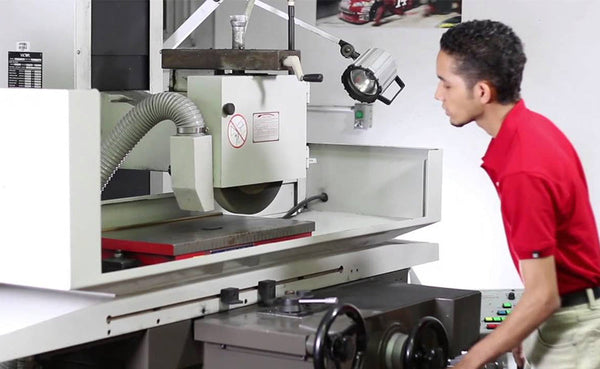
Among the different types of grinding machines we find the horizontal-spindle surface grinder. This machine is used to machine workpieces that have been through other processes, with the aim of refining them. A horizontal-spindle surface grinder can produce smooth and precise finishes on metallic materials, but it also accepts workpieces made of non-metallic materials.
What is a horizontal-spindle surface grinder?
There are three different types of machining: with metal cutting, without metal cutting and by abrasion. Machining by abrasion is carried out on machine tools called grinding machines, which work using a tool called an abrasive wheel. The horizontal-spindle surface grinder is one of the types of grinding machine used in the metalworking industry and it is used to produce more precise and smoother finishes on workpieces.
Grinding is a type of complementary machining, since the workpiece is worked on other machines such as lathes and milling machines; when the workpiece needs to be perfected and excess material removed, or the surface polished and the finish improved, the grinding machine is used.
In the horizontal-spindle surface grinder, the wheel (housed in the wheelhead) stays fixed, but turns at high speed and approaches the surface of the workpiece to be machined. The wheel is characterised by its hardness and strength, and by being made up of bonded abrasive grains that wear down over time. In this type of grinder, the worktable, on which the workpiece to be machined is held, moves from left to right beneath the abrasive wheel.
Abrasive wheels turn at high speed, but it is important to control that speed. When the wheel speed exceeds what is permitted, the tool can disintegrate, injuring the operator and causing machine failures.
Features of the horizontal-spindle surface grinder
The horizontal-spindle surface grinder is able to grind metal surfaces so that they end up flat and aligned. Thanks to the abrasive wheel, the different heights on the surface of a workpiece can be eliminated.
A surface grinder has several parts, but the most important are the abrasive wheel and the table. The wheel, as already mentioned, must be of high quality and resistant to abrasion, wear, high speeds and temperature. The table, for its part, must be movable and able to hold the workpiece. The table has a chuck to which the workpiece is clamped using one of the many workholding systems.
Once the workpiece has been placed on the table, the table is set up by adjusting the height so that it sits just below the wheel. When the wheel reaches the desired speed, the table moves from left to right, while the wheelhead is lowered slightly. The surface of the wheel approaches that of the workpiece tangentially in order to remove the excess material.
This type of grinder is also characterised in that the wheel rotates on the horizontal spindle; its movement is circular, and that of the table, reciprocating. The horizontal-spindle surface grinder offers high accuracy for flat, simple surfaces.
How do you grind flat surfaces?
Before working a workpiece on a horizontal-spindle surface grinder, the relationship between the abrasive wheel and the workpiece material must be established. For example, grinding cast iron, as well as different types of steel, is very easy for the operator. This is not the case with aluminium, stainless steel, plastic and brass; these materials get very hot and can corrode or stick to the wheel. This would damage not only the workpiece, but also the tool and the grinder itself.
The grinding process for flat surfaces is rather slow, because of the precision required for machining; it is important to monitor the wheel speed to avoid damage to the workpiece that can be caused by vibrations. That is why grinding machines are large machine tools built from robust materials.
The movement of the table, which takes place on guideways, can be driven hydraulically or electrically; but the great majority of today's grinders have manual devices for the initial setup of the grinding process. In addition, many grinders can be programmed to set the depth of cut as well as the number of passes the wheel will make over the workpiece.
This machine, moreover, works thanks to three axes of movement. The abrasive wheel is mounted on the Z movement axis, which is vertical: the wheelhead moves up and down along it to bring the wheel close to the surface of the workpiece; perpendicular to this axis runs the X axis of movement. The X axis is characterised by being parallel and horizontal to the surface on which the workpiece is held. Lastly, the horizontal-spindle surface grinder has a Y axis that is horizontal and perpendicular to the X axis; thanks to this axis the table moves transversely beneath the wheel.
Frequently asked questions
What is a tangential surface grinder and what is it used for?
It is a grinding machine that works by abrasion with an abrasive wheel to leave flat, smooth, aligned surfaces, eliminating height differences in the workpiece. It is used as a complementary machining process, to perfect parts that have already been worked on lathes or milling machines, and it accepts both metallic and non-metallic materials. It offers great accuracy on flat, simple surfaces.
How does a tangential surface grinder work?
The wheel, mounted in the wheelhead on a horizontal spindle, rotates at high speed in a fixed position while the table with the workpiece moves from left to right beneath it. The wheel approaches the surface tangentially and removes the surplus material. The table moves on guideways with hydraulic or electric drive, and many machines allow the depth and number of passes to be programmed.
Which materials are hardest to grind on a surface grinder?
Cast iron and the various types of steel are ground easily. Aluminium, stainless steel, plastic and brass, on the other hand, heat up a lot and can corrode or stick to the wheel, which damages the workpiece, the tool and the grinding machine itself. That is why, before starting, the relationship between the wheel and the workpiece material must be established.
Why must the wheel speed be controlled?
Because if the wheel exceeds the permitted speed it can disintegrate, injure the operator and damage the machine, and because an unsuitable speed causes vibration that damages the workpiece. That is why the wheel must be of good quality and resistant to abrasion, wear, high speeds and temperature, and surface grinding is done without haste, on large, robust machines.
Keep reading
Articles →

Looking for machinery for your workshop?
We will advise you with no obligation: a demonstration at our premises, commissioning and our own in-house service and support.