

Features of cylindrical grinders

In this article
In the metalworking industry there are three types of machining: with metal cutting, without metal cutting and by abrasion. The latter is carried out using a tool called an abrasive wheel, whose purpose is to remove the excess material from a workpiece that has previously undergone another machining process such as turning or milling. Machining by abrasion uses specific machine tools called grinding machines.
Machining by abrasion
Grinding machines are characterised by removing only small quantities of material, unlike other machine tools that machine by metal cutting. Grinding is a finishing process for workpieces that require specific tolerances and need to be improved using this technique. The refinement of the finish covers dimensional characteristics (diameter, length and angles); geometric characteristics (parallelism, perpendicularity, concentricity) or surface finish (roughness, lay direction).
Abrasion is regarded as precision machining and is a slow technique used on very hard materials that cannot be machined by other means. It is also used on workpieces that need precise finishes that cannot be obtained by other processes such as drilling, turning, milling and so on.
Grinding machines consist of a frame that houses the abrasive wheel, which is resistant to wear, heat and breakage; abrasive wheels can reach up to 30,000 revolutions per minute (rpm). Depending on the characteristics of the workpieces, some types of grinding machine are:
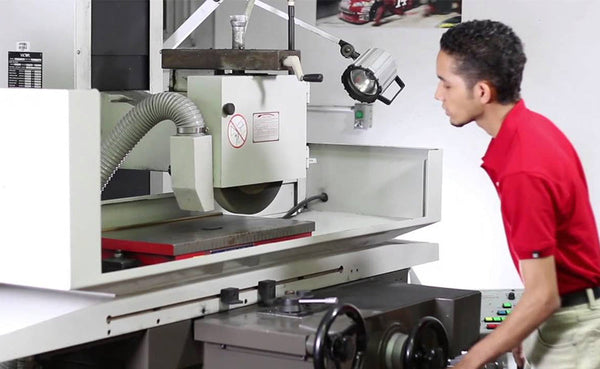
- Surface or tangential grinders, with a head that holds the wheel and a longitudinal slide on which the workpiece is placed. They are used for grinding dies and flat surfaces.
- Centreless or without centres, meaning they have no centres: this type of grinder is used for small workpieces such as bushes. It is ideal for series production. It is a type of cylindrical grinder.
- Universal grinders: used for machining the outside diameters of shafts.
What is a cylindrical grinder?
This type of machine tool is used for high-precision abrasive machining, but it is also used for lapping and polishing. The workpieces that cylindrical grinders handle are made of steel hardened by heat treatment and have been previously machined on other machine tools. After a first machining process, the workpieces are left with an excess of material that can only be removed with the help of an abrasive wheel.
Cylindrical grinders are characterised by having a central axis of rotation, but, in turn, this type of grinder is divided into three:
- External: used for grinding the external surfaces of a workpiece between centres and allowing it to rotate. The abrasive wheel turns in the same direction when it comes into contact with the surface of the workpiece.
- Internal: so called because the machining is done inside the workpiece. In this type of cylindrical grinder, the abrasive wheel is smaller than the width of the workpiece, which is held by a magnetic ring that prevents it from moving.
- Centreless: these grind small cylindrical workpieces such as bushes. This type of grinder has two abrasive wheels between which the workpiece to be machined is placed. The abrasive wheels turn in the opposite direction to the workpieces. It is important to note that this type of grinder has a solid bed on which two heads are mounted on slides. The wheels can be working wheels (fixed) and regulating wheels (swivelling).
Cylindrical grinders are characterised by the fact that the workpiece must have a central axis of rotation; they are also large machines, and the wheelhead can run at different speeds to suit the machining needs of the workpieces.
The importance of the grinding wheel
The most important part of cylindrical grinders is the abrasive wheel, also called the grinding wheel. This is a tool used for removing excess material. Abrasive wheels have the particular ability to remove small amounts of very hard material, which means that the workpieces to be machined can have small dimensions. It is thanks to this quality that grinding can meet tolerance limits that cannot be reached with other processes such as turning.
Grinding wheels have notable properties. To begin with, they have an indeterminate number of cutting edges. In addition, of course, they are made up of abrasive grains and these grains each remove a very small amount of material; the grains are held together by a bond or binder. Because the cutting points of the wheel are positioned randomly, it is impossible to control the position and shape of each of these grains. These tools must be very hard-wearing, so they are made from abrasive materials such as corundum and silicon carbide. On the other hand, the grinding process consumes a lot of energy: 10% is consumed by the wheel and 80% is lost as heat.
Frequently asked questions
What is a cylindrical grinder?
It is a machine tool that machines by abrasion, with high precision, parts that have a central axis of rotation; it is also used for lapping and polishing. It works on heat-treated hardened steel parts that have already been machined on other machines and, with an abrasive wheel, removes the small excess of material left after that first machining.
What types of cylindrical grinder are there?
There are three types: external, internal and centreless. External grinders grind the outer surface of a workpiece that rotates held between centres. Internal grinders work the inside of the workpiece, which is held by a magnetic ring. Centreless grinders grind small cylindrical parts, such as bushes, placed between two wheels, and are ideal for series production.
Why is a part that has already been turned or milled ground?
Because grinding achieves tolerances and finishes that cannot be obtained by turning, milling or drilling. The wheel removes very small amounts of material, even in very hard materials, and improves dimensions (diameter, length and angles), geometry (parallelism, perpendicularity and concentricity) and surface finish (roughness and lay direction).
What is the grinding wheel of a grinder made of?
The grinding wheel is made up of abrasive grains bonded together with a binder. Each grain removes a very small amount of material on its own and, taken together, the wheel has an undefined number of cutting edges. As it has to be very tough, it is made from abrasives such as corundum or silicon carbide.
Keep reading
Articles →

Looking for machinery for your workshop?
We will advise you with no obligation: a demonstration at our premises, commissioning and our own in-house service and support.