

Why buying conventional machine tools is still a good option

In this article
Conventional machine tools in 2024 are still a good option.
Despite the emerging shift in the machining sector towards automation and numerical control technologies, the conventional machine tool still has a place in 2024 and remains a good option; we explain why.
In general, the use of conventional machine tools is expected to decline as CNC technology continues to improve and becomes more affordable. However, some people or companies are also likely to keep using conventional machinery because of their experience, its cost and its versatility.
At Heller Maquinaria we would like to list several reasons why it is still a good option, or at least one worth considering, to use conventional machinery in the workshop or in production:
Cost:
As mentioned above, conventional machine tools are generally cheaper than CNC ones, so they can be a more affordable option for some companies.
In recent years, the shift from working with conventional machinery to working with CNC machinery has accelerated. Fewer and fewer conventional machinery manufacturers remain in the world, while more and more new manufacturers of programme-controlled machines are appearing.
However, the high price of CNC machines compared with conventional machines is still significant and today remains a strong reason to opt for conventional.
Experience:
Some companies may have a great deal of experience and knowledge in the use of conventional machinery, and may feel more comfortable working with it.
Numerically controlled machines require programming knowledge, unlike conventional ones. In addition, the different options the market offers in numerical controls mean that in most cases companies tend to opt for one particular brand of control: FANUC, SIEMENS, FAGOR, HEIDENHAIN, MITSUBISHI.
This problem does not arise with conventional machinery, since only basic machining knowledge is required and, most of the time, the most complicated task is programming the digital readout (DRO) that comes with the machine.
Small-scale production
The conventional machine tool is ideal for small production runs, since it does not require programming or software setup and is more flexible when changes are needed. In this case, industrial maintenance companies or maintenance departments still use industrial machinery because, as we have mentioned, of its cost and because it does not require programming knowledge as CNC machines do.
Specific projects:
Some specific projects may require tools and techniques that can only be carried out with conventional machinery.
Limited resources:
For companies with limited financial, human and technological resources to adopt CNC machinery, continuing to use conventional machinery is a production solution well worth considering.
Long product life:
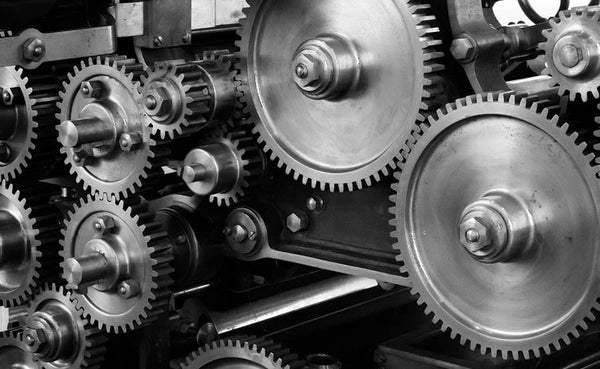
In general, the conventional machine tool has a longer service life than any CNC machine. Conventional machines work with more rudimentary mechanisms (gears, pinions, belts, etc.) than numerically controlled ones, so repairing or modernising a conventional machine is always cheaper than repairing CNC machines, whose electrical components can suffer from planned obsolescence.
It is important to mention that there is no single correct option, and each company must carefully assess its needs and resources to determine which type of machinery is the best option for its workshop or production, but at Heller we consider that conventional machinery still has an important role in industry.
At Heller we specialise in conventional machinery: lathes, milling machines and drilling machines as our flagship products, as well as grinding machines, slotting machines and gear cutting machines for metal-cutting work, and guillotine shears and press brakes for sheet metal.
Heller has a wide range of conventional machinery, backed by the quality of its in-house service team, which oversees each machine, delivering accuracy and quality.

Frequently asked questions
Is buying conventional machinery still a good option?
Yes. Although the sector is moving towards CNC, the conventional machine tool is still an option worth considering because of its cost, the experience many workshops have with it and its versatility. It is cheaper, requires no programming, suits small production runs well and has a longer service life. Even so, each company must assess its own needs and resources.
Why does conventional machinery last longer than CNC?
Because it works with simpler mechanisms, such as gears, pinions and belts, than those of a numerically controlled machine. That is why repairing it or carrying out a retrofit is always cheaper than repairing a CNC machine, whose electrical components may suffer from planned obsolescence. In general, a conventional machine has a longer service life than any CNC machine.
What skills are needed to operate a conventional machine compared with a CNC machine?
For a conventional machine, basic machining knowledge is enough; the most complicated part is usually programming the digital readout that comes with it. Numerically controlled machines, on the other hand, require programming skills, and the variety of controls on the market (Fanuc, Siemens, Fagor, Heidenhain or Mitsubishi) usually leads users to settle on one particular brand.
What types of company is conventional machinery best suited to?
It is ideal for small production runs, because it requires no programming or software setup and adapts better to changes. That is why it is still used by industrial maintenance companies and departments, by workshops with experience of these machines, by projects that need techniques specific to conventional machining, and by companies with limited financial, human or technological resources for adopting CNC.
Keep reading
Articles → Machining and workshop
Heller Maquinaria recibe una ayuda INPYME 2026 de la Generalitat Valenciana
 Machining and workshop
Which machine tool does your sector need? Technical guide by industry
 Machining and workshop
Key advantages of choosing conventional machinery: reliability, durability and direct control
Looking for machinery for your workshop?
We will advise you with no obligation: a demonstration at our premises, commissioning and our own in-house service and support.