

Which conventional milling machine best suits my needs

In this article
At Heller we want to analyse all the types of conventional milling machines that exist, with their advantages and disadvantages, to determine which machine best suits your needs.
Analysis of conventional milling machines
Current situation
The current trend in the machining sector is that CNC milling machines are becoming increasingly affordable and accessible for workshops and factories of all sizes. CNC milling machines have gained ground in the market over recent decades thanks to their greater accuracy, speed and flexibility.
However, conventional milling machines are still used for specific jobs where accuracy and speed are less important, or for jobs that require special or large tools that cannot be used on a CNC milling machine.
To get into the analysis of milling machines properly, we will first divide or differentiate the different types of conventional milling machine.
As we have already mentioned in another post, we distinguish milling machines according to the orientation of the spindle, so we can find: vertical, horizontal and universal milling machines.

Having made this classification, we now focus on analysing the advantages and drawbacks of conventional milling machines. Here we focus on the Heller product range, made up of universal milling machines (and milling machines with motorised ram), vertical, turret and combined turret machines. As you will see throughout the post, some Heller models have a horizontal spindle for machining parts.
Advantages and drawbacks of conventional milling machines: universal, turret, combined turret and vertical
Universal milling machine:
Advantages: they are versatile and are used for a wide variety of jobs, can work with different types of tools and have great accuracy.
Drawbacks: they are larger than other milling machines, and may take longer to set up and adjust for different jobs.
Motorised ram milling machines
Conventional milling machines with a motorised ram have several advantages:
On the one hand, the motorised ram gives better control over the movement of the milling head, which translates into greater cutting accuracy. It also allows a higher cutting speed and flexibility in working capacity, since different types of cuts and jobs can be done with a single machine.
On the other hand, it reduces the physical effort required to move the milling head. Precise adjustments can be made at the push of a button, which is especially useful for large, heavy jobs.


View Heller universal milling machines
Vertical milling machine:

Advantages: they are ideal for working with large, heavy parts, have greater accuracy and are easier to use and maintain.
Drawbacks: they are less versatile than other milling machines.
View vertical milling machines
Turret milling machine:
Advantages: they are smaller and cheaper than universal milling machines, and have quick tool changes.
Drawbacks: they are less versatile and less accurate than universal milling machines.
Combined turret milling machine
Advantages: it combines the features of a universal and a turret milling machine, offering greater versatility and accuracy.
Drawbacks: they are larger than turret milling machines.

View the turret milling machines
By way of a summary or final analysis, it must be said that there is no conventional milling machine that is «the best», as this will depend on the specific needs of the job to be done and on the budget.
It is important to research and compare the specifications of several models before making a decision, and to consider aspects such as size and capacity, accuracy, motor power, variable cutting speed, durability and reliability, ease of use and maintenance.
It is also important to consider the service and support and the availability of spare parts, as this will be key to the correct operation of your milling machine in the long term.
Frequently asked questions
What types of conventional milling machine are there?
Depending on the orientation of the spindle, there are vertical, horizontal and universal milling machines. A distinction is also made between the turret machine, the combined turret machine and the universal machine with motorised ram. The vertical machine is ideal for large, heavy parts, accurate and easy to use and maintain, although less versatile than the others.
What is the difference between a universal milling machine and a turret one?
The universal machine is more versatile: it is suitable for a wide variety of jobs, accepts different types of tool and is highly accurate, but it is larger and requires more set-up time. The turret machine is smaller and cheaper and changes tools quickly, although it is less versatile and less accurate. The combined turret machine brings together the advantages of both, in exchange for being larger than the turret machine.
What are the advantages of a milling machine with a motorised ram?
The motorised ram moves the head with more control, which gives greater cutting accuracy, and allows higher cutting speed and the flexibility to do different jobs with a single machine. It also reduces physical effort: precise adjustments are made at the push of a button, which is especially useful on large, heavy jobs. One example is the Heller FCM1600 universal milling machine.
How do you choose a conventional milling machine?
There is no single conventional milling machine that is the best: it depends on the work to be done and on the budget. It is worth comparing several models for size and capacity, accuracy, motor power, variable cutting speed, durability, reliability, ease of use and maintenance. It is also essential to have service and support and availability of spare parts so that the machine performs well in the long term.
Keep reading
Articles →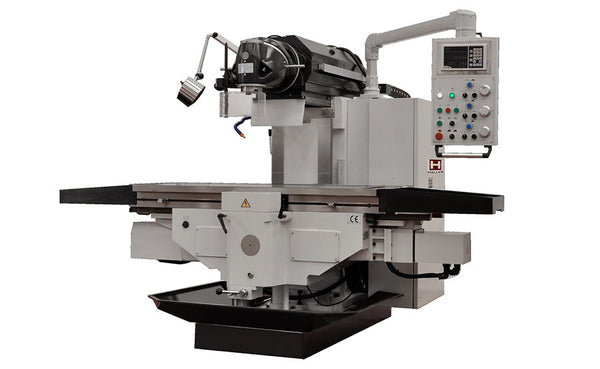


Looking for machinery for your workshop?
We will advise you with no obligation: a demonstration at our premises, commissioning and our own in-house service and support.