

What is a vertical milling machine used for?

In this article
The milling machine is a machine tool widely used in machining workshops. It works through the action of a tool with multiple cutting edges, called a milling cutter, which approaches the surface of the workpiece to be machined, producing metal cutting with swarf removal. Among the different types of milling machine, there is the vertical milling machine, but what is it used for and how does this machine tool work?
What is a vertical milling machine?
In metalworking there are three different types of machining: machining without swarf removal, machining with swarf removal and machining by abrasion. Machining with swarf removal takes away small amounts of material in the form of thin strips (called swarf). One of the machines capable of this type of machining is the milling machine. Among the different types of milling machine found in industry, there is the vertical milling machine.
The vertical milling machine is one of the most widely used machine tools in machining workshops thanks to its versatility. This type of machine removes surplus metal from a workpiece by means of a rotating tool called a milling cutter. The cutter is rotating and fitted with several teeth, cutting edges or inserts of a very hard, durable metal.
This machine tool follows a longitudinal path along the workpiece while performing a rotary movement. These movements remove the surplus material from the surface of a workpiece and give it the shape you want.
Types of milling machine
Before explaining what a vertical milling machine is used for, it is important to point out that there are many types of milling machine today. They can be classified by the orientation of the axis of rotation or by the number of axes available for machining. Among the types of milling machine classified by tool orientation, we find:
- Horizontal milling machine: fitted with cylindrical cutters mounted on a horizontal arbor, which allow slot cutting (machining by slotting) on different workpieces.
- Vertical milling machine: in which the axis, as its name suggests, lies in the vertical plane. This type of milling machine is widely used because it allows deeper cuts than those made by the horizontal milling machine. Vertical milling machines can in turn be sub-classified: bed-type and turret or knee-type.
- Universal milling machine: can be fitted with either the horizontal or the vertical axis. It is not a very widely used milling machine, but it has the particular feature of being able to be converted into a vertical machine, as long as the necessary accessories or tools are used.
Features of the vertical milling machine
On the vertical milling machine, the tool-holding spindle is positioned so that the cutter can rotate about its horizontal axis and perpendicular to the workpiece, which is clamped on the worktable. On this machine, the cutting tool has an upward and downward movement by which the spindle approaches the surface of the workpiece directly.
As we have already mentioned, the vertical milling machine can be divided into two types:
- Bed-type vertical: the only movement is that of the cutter, while the head stays static. The movement comes from the table.
- Turret or knee-type vertical: its head can move horizontally and through up to 180º, following the horizontal axis of the workpiece.
On the vertical milling machine, moreover, the base and column are made of cast iron and the head housing the spindle can move up and down; the heads on these machines can be fixed or swivelling and the workpieces being machined move in the horizontal or vertical planes.
What is a vertical milling machine used for?
Because the axis of this type of machine tool is perpendicular to the worktable, many different machining operations can be carried out. One of the most common is the roughing of materials, which makes it possible to produce complex workpieces of any design.
In addition, because the spindle moves directly over the table, or the workpiece moves towards the head, always in the vertical direction, it is possible to carry out step milling and machine parallel slots (slotting) of different depths, shapes and cavities. A vertical milling machine can also work flat surfaces and machine different shapes such as gears and decorative elements; for this reason its use has spread to different industrial sectors.
Among the machining processes that can be carried out on these machines, in addition to those mentioned above, the production of cams, dies and moulds, as well as drilling or hole-making, stand out. It is also worth pointing out that this machine has the advantage of accepting workpieces in a range of materials such as metal (different types and hardnesses), wood, plastic and so on. Thanks to all these features and functions, the vertical milling machine is used in a huge number of industries, besides metalworking. It can be found in the automotive, aerospace and food sectors, among others.
Frequently asked questions
What is a vertical milling machine used for?
It is used for roughing, working flat surfaces, cutting parallel slots and stepped work at different depths and shapes, drilling, and machining gears, cams, dies, moulds and decorative elements. Because the cutter axis is perpendicular to the table, it allows many operations and parts made of metal, wood or plastic, so it is used in the automotive, aerospace and food industries, among other sectors.
What is the difference between the vertical, horizontal and universal milling machine?
They are distinguished by the orientation of the tool axis. The horizontal machine carries cylindrical cutters mounted on a horizontal arbor and is used mainly for slotting. On the vertical machine, the axis lies in the vertical plane, which allows deeper cuts than on the horizontal one. The universal machine can work with a horizontal or a vertical axis if the necessary attachments are fitted.
How does a vertical milling machine work?
The cutter, a rotating tool with several teeth or cutting edges of very hard metal, is mounted in the spindle, perpendicular to the workpiece clamped on the table. The head that houses the spindle moves up and down, and the workpiece moves in the horizontal or vertical planes, so that the cutter removes the excess material in the form of swarf until the part has the desired shape.
What types of vertical milling machine are there?
There are two: bed-type and turret or knee-type. On the bed-type machine, the head stays static, the cutter only rotates and it is the table that moves. On the turret or knee-type machine, the head allows horizontal movements of up to 180 degrees following the horizontal axis of the workpiece. On both, the base and the column are made of cast iron.
Keep reading
Articles →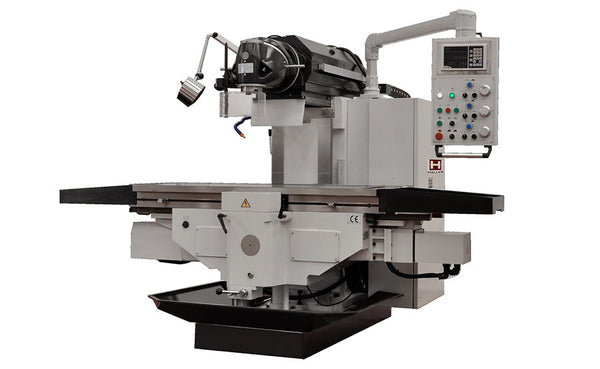


Looking for machinery for your workshop?
We will advise you with no obligation: a demonstration at our premises, commissioning and our own in-house service and support.