

What is a universal milling machine?

In this article
If you have ever wondered what a universal milling machine is, you should know that it is one of the most versatile and widely used machine tools in machining workshops. Thanks to this machine it is possible to machine parts by metal cutting.
Features of the milling machine
The milling machine is a machine tool whose purpose is the machining of parts by metal cutting. This is possible thanks to the movement made by the milling cutter, which is the cutting tool of this machine; the cutter is rotary and has several cutting edges, which are what approach the surface of the workpiece to be machined to remove the surplus material in the form of swarf. Each milling machine works differently, but in traditional machines the cutter rotates while remaining fixed and it is the workpiece that moves towards the tool.
What is a universal milling machine? Are there different types of milling machine? Which is the best? The universal milling machine, as we know it today, was created by Joseph Brown in 1861. This machine was used for the first automated production and with movement along three axes. Brown created this milling machine with the aim of machining spirals by machine, something that at that time could only be done by hand. This first milling machine was equipped with a dividing head for the manufacture of spur and helical gears. Before this machine, Frederic Howe designed a universal model that never became as popular as Brown's milling machine. However, Howe's machine, which included a device for copying profiles, was the inspiration for the modern milling machine.
Milling machines are used to carry out a wide variety of machining operations on parts of different materials and shapes. On these machines it is possible to work flat surfaces or irregular profiles, but they are also used for machining threads, gears, slots, keyways, etc.
Types of milling machine
Milling machines can be classified in different ways, such as by the orientation of the cutting axis or the number of axes. Universal milling machines belong to the first classification, that is, where the cutting axis is located relative to the workpiece. Thus, milling machines can be vertical, horizontal and universal.
In vertical milling machines, the spindle axis is perpendicular to the worktable, whereas in the horizontal milling machine the axis of rotation is horizontal to the table. Universal milling machines are a mix of these two types.
What is a universal milling machine?
Universal milling machines are used for machining different solid materials and are characterised by being able to carry out many types of machining. Universal milling machines are fitted with a long table that has an adjustable head suspended above it. Almost the whole body of the machine is made of cast iron, as this makes it incredibly resistant to heat and machining speeds.
Why are universal milling machines better? Unlike conventional milling machines, universal ones have a wider range of movement. On these machines, for example, machining can be done horizontally, but also in the vertical plane. As we have already mentioned, there are vertical and horizontal milling machines, and these can only move in one plane or the other, never both.
Now that you know what a universal milling machine is, it is important to know that there are combinations of these milling machines with the most common types. For example, the universal horizontal milling machine is similar to the plain horizontal one; the difference between these two machines is that the universal model has a swivelling worktable. Thanks to this arrangement the table can move to 45 degrees from a horizontal position.
The operating principle of universal milling machines is similar to that of other machine tools of this kind. They are fitted with a milling cutter with several cutting edges, which is responsible for removing the surplus material from the surface of the workpiece.
Uses of universal milling machines
These machines are used today for the milling of parts with different characteristics. On a universal milling machine, for example, machining by angular milling or helical milling can be carried out. But this type of milling machine is so versatile that it can equally be used for precision work or for very easy and less demanding machining.
To machine on a universal milling machine, the work can be done manually or semi-automatically. These machines are also available in different sizes; it all depends on the characteristics of the machining to be carried out.
Unfortunately, universal milling machines require more maintenance than conventional milling machines; this is due to their complexity and to the wide variety of parts they accommodate, which can fail and cause breakages. Despite this drawback, universal milling machines are still very popular in the machining industry thanks to their versatility, flexibility and the ability to carry out multiple jobs. They are also very efficient and durable.
Frequently asked questions
What is a universal milling machine?
It is a milling machine that combines the horizontal and the vertical: it can machine in the horizontal plane and also in the vertical one, whereas vertical and horizontal milling machines work in only one of the two planes. It has a long table with an adjustable head suspended above it and a body made almost entirely of cast iron, resistant to heat and to machining speeds.
Who invented the universal milling machine?
The universal milling machine as we know it today was created by Joseph Brown in 1861 to machine spirals mechanically, something that until then could only be done by hand. It carried a milling head to produce spur and helical gears. Earlier, Frederic Howe had designed a universal model with a device for copying profiles which, although less popular, inspired the modern milling machine.
What are the advantages and disadvantages of a universal milling machine?
Its main advantage is versatility: it has a wider range of movement than conventional milling machines, allows angular or helical milling and is suitable for both precision work and simple machining. It is also efficient and durable. Its drawback is that it needs more maintenance, because of its complexity and the wide variety of parts that can fail.
What is the difference between the plain horizontal milling machine and the universal one?
The universal horizontal milling machine is similar to the plain horizontal one, but it has a swivelling worktable that can move 45 degrees from the horizontal position. On both, the axis of rotation of the tool is horizontal relative to the table, unlike the vertical milling machine, in which the spindle axis is perpendicular to the table.
Keep reading
Articles →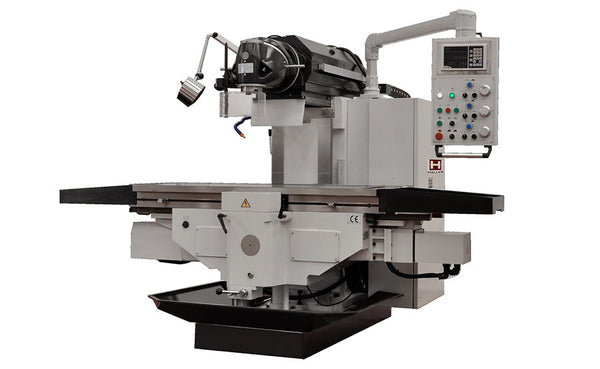


Looking for machinery for your workshop?
We will advise you with no obligation: a demonstration at our premises, commissioning and our own in-house service and support.