

What is a transverse milling machine?

In this article
What is a transverse milling machine? In fact it is one of the parts of a milling machine, which can cause confusion. In the metalworking industry, milling machines are widely used in machining workshops because of their great versatility and all the functions they offer.
What is a milling machine?
The milling machine is a machine tool that machines by swarf removal; swarf is the thin strips of metal that are removed to shape the workpiece. But to remove swarf you need to use the milling cutter, a tool that is clamped in the head of the machine and has one or more cutting edges that approach the surface of the workpiece.
The cutter has a rotary movement. However, the milling process depends on the type of milling machine used. On traditional milling machines, it is the cutter that rotates in a fixed position and swarf is produced as the workpiece approaches the cutting tool.
This machine tool is one of the most widely used in machining workshops thanks to its versatility. It is used, for example, for the machining of flat surfaces, irregular profiles, drilling, boring holes, slotting keyways, setting dimensions precisely, tapping and cutting gears, among other functions.
In addition, many different materials can be worked on this machine: steel, metals (ferrous and non-ferrous), wood, iron and other synthetic materials; the workpieces can have flat or curved surfaces, and can also include slots and toothed parts. Finally, after milling, the resulting workpieces can go on to other processes such as grinding and roughing.
Parts of the milling machine
Before talking about the transverse milling machine, it is important to look at the parts of this machine tool. There are different types of milling machine in industry, so their parts may change position and have more or fewer functions:
- Base: supports the machine itself (it includes the support for the column, the head, the table and the slides).
- Column: holds the head. This part of the milling machine can be swivelled and allows machining at different angles.
- Head: houses the motor as well as the gearbox. These drive the main spindle.
- Main spindle: this part of the milling machine moves the toolholder, where the milling cutter (or whatever tool is to be used for machining) is located. The main spindle provides rotation to the tool.
- Slides: on the milling machine you can distinguish the longitudinal, cross and vertical slides. The first moves along the X axis; the second carries the longitudinal slide and slides along the Y axis; finally, the cross and longitudinal slides sit on the vertical slide, which only allows movements along the main axis of the milling machine.
Transverse milling machine or transverse movement?
You may have heard the expression “transverse milling machine”, but it is important to point out that this is not a type of milling machine; it refers to one of the slides of this machine tool, as well as to one of the movements of its table.
To begin with, the table of the machine tool has five different movements: longitudinal, transverse, vertical, and rotation about the longitudinal axis and about the vertical axis.
The first movement is always along the X axis (working movement); the transverse movement, for its part, takes place along the Y axis. This movement is used to place the milling cutter in the right position for machining.
The movement along the Z axis, or vertical movement, as its name suggests, allows the table to move vertically and sets the pass depth. Now, the rotations about the longitudinal axis and about the vertical axis take place about degrees of freedom U and W, respectively. The first can be achieved with the dividing head, while the second allows the table to be turned through 45º.
But the expression “transverse milling machine” can also refer to the cross slide of this machine tool. As we have already mentioned, this slide allows movement along the Y axis, perpendicular to the longitudinal movement of the table (X axis). This slide is made up of a knee and a swivel plate.
The cross slide of the milling machine moves along a series of guideways, and on top of it there is a sort of circular platform on which a plate rotates. This slide makes it possible to orient the worktable. As you can see, the transverse movement of the table and the cross slide are closely linked.
Frequently asked questions
What is a cross-travel milling machine?
The cross-travel milling machine is not a type of milling machine. The expression refers to the cross slide of the milling machine or to the cross movement of its table. This movement takes place on the Y axis and serves to place the cutter in the right position for machining, while the working movement is the longitudinal one, on the X axis.
What movements does the table of a milling machine have?
The table has five movements: longitudinal, on the X axis, which is the working movement; cross, on the Y axis, to position the cutter; vertical, on the Z axis, which determines the depth of cut; and two rotations, one about the longitudinal axis, which is achieved with the dividing head, and another about the vertical axis, which allows the table to be swivelled 45 degrees.
What is the cross slide of a milling machine like?
The cross slide consists of a knee and a swivel plate. It moves on a set of guideways and on its upper part has a circular platform on which a plate rotates, making it possible to orient the worktable. That is why the cross slide and the cross movement of the table are closely linked.
What are the main parts of a milling machine?
The main parts are the base, which supports the machine; the swivelling column, which holds the head; the head, which houses the motor and the gearbox; the main spindle, which rotates the tool through the toolholder; and the longitudinal, cross and vertical slides, which carry out the movements along the machine axes.
Keep reading
Articles →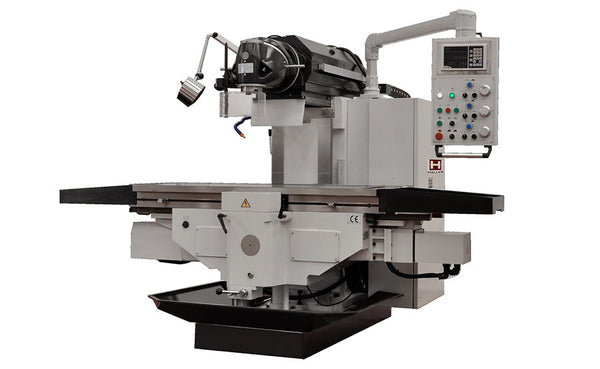


Looking for machinery for your workshop?
We will advise you with no obligation: a demonstration at our premises, commissioning and our own in-house service and support.