

What is a knee-type milling machine?

In this article
The milling machine is a machine tool used to machine workpieces by swarf removal, through the action of a cutting tool called a milling cutter. In metalworking, milling is used to shape different materials: metal, steel, wood, iron, and so on. A milling machine can machine workpieces with complex shapes.
Types of milling machine
Milling machines machine workpieces by swarf removal, through the rotary movement of the cutter, which has several cutting edges. The milling machine is a very versatile machine that can machine different workpieces made of all kinds of materials; in addition, depending on its type, a milling machine can carry out various kinds of machining. A milling machine can mill, drill, bore, slot, and so on.
Because of the needs of industry, milling machines have diversified and adapted to new technologies, so you can find different types of machine tools for milling workpieces. Although these milling machines share a common basis, they differ from one another according to the sector in which they are used.
Milling machines can be classified in different ways, the most common being by the orientation of the tool or axis of rotation, and by the number of axes in the operation. Here we focus on the classification by tool orientation, because this is where knee-type milling machines are found.
By tool orientation
Following the orientation of the cutter's axis of rotation, you can find three different types of milling machine:
- Horizontal: with cylindrical cutters mounted on a horizontal arbor driven by the head of the machine, supported at one end by the head and at the other end by a bearing on the ram or sliding bridge. It is mainly used for slotting.
- Vertical: where the spindle axis is positioned vertically and perpendicular to the worktable. The cutters are mounted on the spindle and rotate about their own axis. Vertical milling machines can in turn be bed-type and knee-type or turret milling machines.
- Universal: this milling machine has a main spindle that allows horizontal tool arbors to be fitted, as well as a head that attaches to the spindle and means that the milling machine can be converted into a vertical one.
What is a knee-type or turret milling machine used for?
The vertical milling machine is characterised by having the spindle axis positioned vertically and perpendicular to the table. The cutters are mounted on the spindle and rotate about their own axis, and both the spindle and the table can move vertically; this movement increases the depth of cut. The knee-type or turret milling machine is a vertical milling machine in which the spindle stays stationary, without moving, while cutting operations are carried out; the worktable, however, can move horizontally and vertically.
Thanks to the orientation of the axis, this type of milling machine is used for step milling of workpieces, and for cutting straight or shaped slots and cavities. In addition to these operations, with a knee-type milling machine it is possible to machine workpieces by swarf removal.
A knee-type milling machine can work different flat surfaces, as well as gears and even decorative elements; this means that turret milling machines are used in many industries. These machines also accept many different materials for machining: wood, metal, steel, plastics and tiles, among others.
Features and operation of the turret milling machine
The knee-type milling machine is characterised by a sort of arm that allows the table to move along the vertical axis: up and down. This allows the machine to make deep or shallow cuts in the workpiece; as a result, workpieces with very complex finishes can be machined.
When the operator actuates the arm and the lever under the table, they can make the various vertical cuts that the workpiece requires. Thanks to this function, the knee-type milling machine means that the workpieces to be machined need less pre-cutting work, since the operator does not have to worry about spindle and table movements, only about operating the table.
Today you can find manual and automatic turret milling machines. On manual machines, the operator has to move the table so that it moves up or down; on automatic knee-type milling machines, you only need to enter the required information so that the tool knows how and where to cut. The movement of the table, whether manual or automatic, makes it possible to obtain rapid variations in power.
Frequently asked questions
What is a knee-type milling machine and how does it work?
It is a vertical milling machine, also called a turret milling machine, in which the spindle with the cutter stays fixed during cutting while the worktable moves horizontally and vertically. By raising or lowering the table with the lever located below it, the depth is adjusted, so that deep or shallow cuts can be made on the workpiece.
What is a knee-type milling machine used for?
It is used for step milling of parts, for cutting straight or shaped grooves and cavities, and for working flat surfaces, gears and even decorative elements. It accepts many materials, such as wood, metal, steel, plastics and tiles, so it is used in many industries.
What is the difference between the horizontal, vertical and universal milling machine?
They are distinguished by the orientation of the cutter axis. The horizontal machine carries cylindrical cutters on a horizontal axis and is used mainly for slotting. On the vertical machine, the spindle is vertical and perpendicular to the table; this includes the bed-type and the knee-type or turret machines. The universal machine accepts horizontal tool arbors and a head that converts it into a vertical machine.
What is the difference between the manual and the automatic knee-type milling machine?
On the manual machine, the operator moves the table to raise or lower it; on the automatic machine, it is enough to enter the necessary information so that the tool knows how and where to cut. In both cases, since only the table is operated, the operator does not have to coordinate the movements of the spindle and the table, and the workpiece needs less pre-cutting work.
Keep reading
Articles →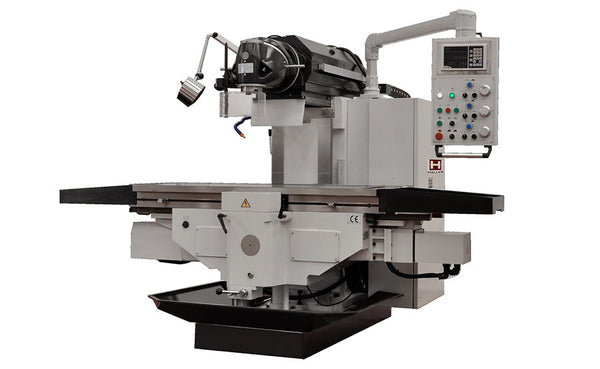


Looking for machinery for your workshop?
We will advise you with no obligation: a demonstration at our premises, commissioning and our own in-house service and support.