

What are the working axes of a milling machine?

In this article
Milling machines are characterised by the cutting tool they use for machining, the milling cutter. They are also characterised by the movement the machine can perform with respect to the Cartesian plane. What are the working axes of a milling machine? What types of milling machine are there according to these axes?
Types of milling machine according to working axes
These machine tools, in which machining is done by removing swarf, can be classified in two ways: according to the orientation of the cutting tool (milling cutter) with respect to the workpiece and according to the number of axes. The number of working axes of a milling machine limits or allows certain machining operations to be carried out.
By the number of axes on which they work, milling machines can be:
- Three axes. This type of machine can control the relative movement between the milling cutter and the workpiece to be machined along the three axes of the Cartesian plane (X, Y and Z).
- Four axes. These machine tools, in addition to allowing movement between the cutting tool and the workpiece along the three axes of the Cartesian system, allow the workpiece to rotate. That is, the machine is able to control the axis of rotation of the workpiece about an axis through a dividing mechanism. This type of milling machine is widely used when parts with a cylindrical shape are to be machined.
- Five axes. Five-axis milling machines are very advanced and complex machines that not only allow movement in the Cartesian plane but also control different rotations of the workpiece. On this machine the workpiece can be rotated about two axes, perpendicular to the tool or parallel to it; but they also allow rotation in the horizontal plane and a degree of tilt on the part of the tool. This type of milling machine allows complex parts to be machined and the angle of reach of the cutter on the surface of the workpiece is greater.
What are the movements of the milling machine?
Milling machines are very versatile machine tools that allow machining by metal cutting. The surplus material is removed from the surface of the workpiece when the cutting tool comes into contact with it. Milling machines make it possible to machine different materials such as iron and cast iron, non-ferrous metals, steel, wood and synthetic materials such as plastic. In addition, parts with different surfaces can be worked on a milling machine: flat, curved, toothed or grooved.
Movement of the milling cutter
On a milling machine, as on any machine tool, the working axes and the travel movements are essential for good machining. The travel can be carried out by the cutting tool, the workpiece or the worktable. In the case of the milling machine, the cutter is usually held in the head, which remains fixed. On these machines the cutter has a rotary movement, as it turns on its own axis.
Even though the tool remains fixed and only rotates about its axis, some types of milling machine allow the angle of tilt of the cutter to be varied. They also allow its position to be extended with respect to the axis about which it rotates.
Table travel
If the cutting tool is fixed on the milling machine, it is the table that has to make the movements so that the cutter can machine the workpiece; the workpiece is mounted on the table and clamped to it. The table movement can be manual or automatic, depending on the type of milling machine. The table can also follow feed rates or rapid traverse with no cutting.
The table can move thanks to the feed gearbox (millimetres per minute), in which the operator must choose the feed required for the machining being carried out.
Movement between the workpiece and the tool
When the workpiece and the cutting tool move relative to each other, three different types of movement can occur:
- Cutting movement: this is the movement made by the tip of the cutter to remove the surplus material.
- Feed: this is the movement by which the tool approaches the surface without cutting.
- Depth of cut or drilling: this is the feed movement that allows the cuts to be deeper.
Movements along the working axes of the milling machine
In addition to the cutting, feed and depth movements (which can in fact be expressed as cutting speed, feed and depth), there are other movements along the working axes of the machine. There can be five of these, and not all milling machines can perform them. It all depends on the type of milling machine used.
The most basic movement, performed by all milling machines, is the longitudinal one. This movement is made along the X axis. For this movement to be effective, the workpiece must be firmly clamped to the table by means of vices. This movement can also be used to cut angles. In addition to longitudinal movement, milling machines have a cross movement along the Y axis. It is simple and basic, as it is used to position the milling machine correctly relative to the workpiece. The third movement is the vertical one and is made along the Z axis. This type of movement is used to set the depth of cut.
However, there are also rotary movements that can be about the longitudinal axis or about the vertical axis. Longitudinal rotation is made possible by a dividing head or by using a tilting table; vertical rotation, for its part, occurs when the table can rotate completely or through angles of up to 45 degrees.
Frequently asked questions
What are the working axes of a milling machine?
There are three basic axes: X, Y and Z. On the X axis the longitudinal movement is made, the most basic and common to all milling machines; on the Y axis, the cross movement, used to position the machine relative to the workpiece; and on the Z axis, the vertical movement, which determines the depth of cut. Some milling machines add rotations about the longitudinal or the vertical axis.
What is the difference between a three-, four- and five-axis milling machine?
The three-axis machine controls the relative movement between the cutter and the workpiece in X, Y and Z. The four-axis machine adds rotation of the workpiece about an axis by means of a dividing mechanism, useful for cylindrical parts. The five-axis machine also controls several rotations of the workpiece and the tilt of the tool, which makes it possible to machine complex parts with a greater angle of reach for the cutter.
What movements are there between the cutter and the workpiece?
There are three: the cutting movement, made by the tip of the cutter to remove the surplus material; the feed movement, with which the tool approaches the surface without cutting; and the depth of cut, the feed that allows deeper cuts. In practice they translate into cutting, feed and depth speeds.
How does the table of a milling machine move?
As the cutter is usually held in a fixed head and only rotates about its axis, it is the table, with the workpiece clamped on it, that moves. The movement can be manual or automatic depending on the milling machine, at working feed rate or at rapid traverse without cutting. The feed is selected on the feed gearbox, in millimetres per minute. Some tables rotate up to 45 degrees or completely.
Keep reading
Articles →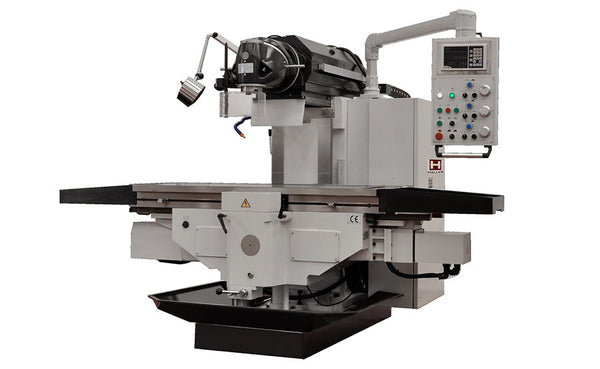


Looking for machinery for your workshop?
We will advise you with no obligation: a demonstration at our premises, commissioning and our own in-house service and support.