

What are the parts of an industrial milling machine?

In this article
An industrial milling machine is a machine especially suited to machining a variety of materials. Metals, all kinds of alloys and wood are most often used on it. The cutting tool, also called a milling cutter, the motor and the horizontal table on which the workpiece to be machined is placed are the most important parts of a milling machine.
The cutter reaches a cutting speed as it rotates, which allows it to machine the workpieces. The machining system is automated. This way, the operator can enter into the machine the precise coordinates for carrying out the job in question on the workpiece. Milling operations can consist of roughing, drilling or cutting the workpiece.
The parts of an industrial milling machine
The different types of milling machine on the market have a series of fundamental parts.
The worktable
The worktable is the support that serves as a base on which to place the workpiece to be machined. This table incorporates a vice or a clamp with which the operator can hold the workpiece so that it does not move or slide during the machining process. Generally, the worktables fitted to industrial milling machines are matched to the size of the workpiece that can be machined. The worktable rests on a rectangular support called the cross slide.
The motor
As with any other machine or tool, the motor is the essential element for the operation of the milling machine. Once the motor is switched on, the cutter starts to rotate, reaching its cutting speed and working with a horizontal, vertical or transverse axis movement. The motor power will depend on the model of milling machine, but it is most common for it to be able to run at even more than 4,000 revolutions per minute.
The hand cranks
Once the workpiece has been placed on the worktable, the cutter has to be lowered to start cutting. The hand cranks are used to lower it. This is one of the parts of a milling machine that can vary depending on the model. In fact, there are 4 different types of crank: vertical, longitudinal, transverse and head. The name of each one indicates the movement with which the worktable will move to machine the workpiece.
The head
The cutter or cutting tool is located in the head. This device enables the operator to place the cutter in different positions to carry out any job. In fact, the head is the part that makes the cutting tool take the angle needed to strike the workpiece. Some more modern milling machines allow the cutter to be replaced with another cutting or drilling element. In this way, the same tool can carry out different jobs.
The spindle
Although the cutter is placed in the head, this cutting tool is inserted in the spindle. It is this part of the milling machine that actually receives the movement driven by the motor in order to move. Thanks to the spindle, the cutter starts to rotate at high speed to carry out the cut or machining on the workpiece. Most milling machines have a gearbox to control the spindle speed. It is the hand cranks that allow us to lower the spindle with the cutter in order to work.
It may also be the case that, depending on the type of milling machine, the spindle can be different. The vertical milling machine, for example, has a vertical spindle, while the horizontal milling machine gets its name from having the spindle in that position.
How an industrial milling machine works
Now that we know the parts of a milling machine, we need to talk about how this machine works.
Once the machine's motor is switched on, the cutter or cutting tool starts to rotate at high speed. The operator, manually or in automated mode, will be responsible for lowering the cutter to the workpiece with the hand cranks in order to remove swarf, rough, drill or cut the material.
The numerical control (CNC) with which today's industrial milling machines work means that all the work is already automated. Before starting the motor, the operator will enter into the machine the coordinates and tasks to follow in order to machine the workpiece. The machine will then take care of the machining without the operator having to intervene. This allows less effort, greater safety and a much higher level of precision.
All of the above are the most important parts of a milling machine, fundamental elements for the operation of this machine, which can have from 3 to 6 axes and has a fixed head that carries the corresponding cutting tools.
Frequently asked questions
What are the main parts of a milling machine?
The main parts are the worktable, where the workpiece is clamped with a vice or clamp; the motor, which turns the cutter; the handwheels, which move the table and lower the cutter; the head, which orients the tool; and the spindle, where the cutter is mounted and which receives the movement from the motor, normally through a gearbox.
What is the spindle of a milling machine for?
The spindle is the part into which the cutter is inserted and which receives the movement from the motor, so that the tool rotates at high speed to cut or machine the workpiece. Most milling machines have a gearbox to control it. Its position gives the machine its name: the vertical milling machine has a vertical spindle and the horizontal one, a horizontal spindle.
What handwheels does a milling machine have and what are they for?
There are four types: vertical, longitudinal, cross and head. Each name indicates the movement with which the worktable moves to machine the workpiece, and they are also used to lower the spindle with the cutter to the workpiece to begin cutting. Their arrangement can vary depending on the milling machine model.
How does an industrial milling machine work?
When the motor is started, the cutter turns at high speed and the operator lowers it onto the workpiece with the handwheels to remove swarf, rough, drill or cut the material. On CNC milling machines, the operator enters the coordinates and tasks beforehand, and the machine machines without intervention, with less effort, more safety and more accuracy.
Keep reading
Articles →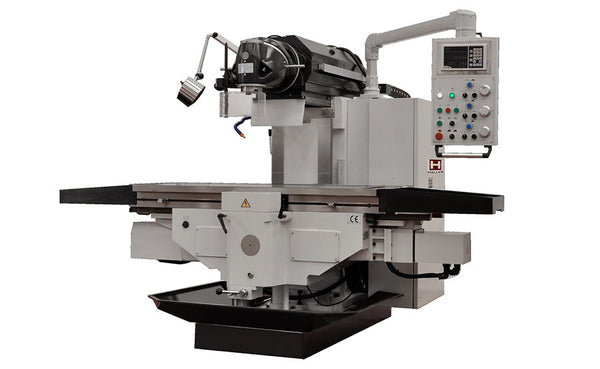


Looking for machinery for your workshop?
We will advise you with no obligation: a demonstration at our premises, commissioning and our own in-house service and support.