

Types of milling machine head

In this article
The milling machine is a machine tool used to machine workpieces by metal cutting, through the movement of a rotating tool called a milling cutter that has several cutting edges. To get good results, it is essential that the milling machine head works properly.
Parts of the milling machine
A milling machine can carry out a wide range of machining jobs on different materials; this machine tool handles steel, non-ferrous metals, cast iron, wood and synthetic materials; it also handles workpieces with curved, flat or slotted surfaces, and so on. In addition, after the milling process, the workpieces can undergo complementary operations such as roughing.
Among the parts of the milling machine (bed, body, arm, spindle, etc.) there is a range of accessories that can be added to the machine to improve its performance.
Accessories for milling machines
The accessories that can be fitted to milling machines make a variety of machining operations easier to carry out, and they also add speed, safety and accuracy. These devices include:
- Additional axes: to orient the axis of the tool holder, a multi-angle head; as well as a universal dividing head with its matching tailstock, gear set and dividing table.
- For workholding: universal three-jaw chucks and back plates; a tailstock, swivel vices and hydraulic vices can also be included.
- Tool holding: cutter arbors, collet chucks and collet sets.
- Accessories for digital readout control.
- Accessories for special operations such as the boring head or the slotting attachment.
Tool holding on the milling machine
Tool holding on the milling machine is achieved through the head, one of the most important parts of this machine. The head makes it possible to orient the cutter to the desired position so that the workpiece can be machined, reaching every angle required.
There are six types of head for universal milling machines:
- Universal.
- Huré.
- Gambin.
- Vertical.
- Orthogonal.
- Slotting.
Universal dividing head
The universal head is installed on a base fixed to the bed of the milling machine. It has a circular rotating plate that lets the head rotate in the vertical plane. It includes a graduated scale for setting angles in degrees. The other part of this milling machine head is the swivelling body, fixed to the base of the divider, which allows the spindle to be tilted and moved to any angle relative to the table. The swivelling body is in turn mounted on one part that rests on the table and another that serves to house the cutter holder and rotates in a plane perpendicular to the table.
Huré milling machine head
The Huré universal vertical head is a type of milling machine head that delivers excellent performance and benefits for this machine tool. To begin with, this head can be used in the different types of milling: vertical, horizontal, radial in the vertical plane, angular in the perpendicular vertical plane and oblique to the horizontal plane. This head suits universal milling machines, but not vertical milling machines.
This head is made up of three parts:
- Base body: fixed to the frame, with a circular platform on which the rest of the head rotates in a vertical plane.
- Intermediate body: which rotates on the platform of the base body and is locked to it. It also has another circular platform in a plane inclined at 45°.
- Cutter-holder body: where the working spindle is fitted. This spindle rotates on the inclined platform of the intermediate body and remains fixed to it.
The design of the head allows milling tools, drill bits and so on to be fitted by means of collets, drill chucks and other clamping elements. The spindle of this head turns at the same speed as the main spindle of the machine.
Gambin head
The Gambin milling machine head was one of the first heads to be designed. It is less robust than the Huré, which reduces its strength somewhat, but it is much easier to orient relative to the workpiece; this quality is due to the fact that the rotation axes of this head are octagonal. To position the head, the screws supplied with it must be adjusted.
In this head, the outer main body can rotate and tilt to any angle; in addition, the spindle carrier rotates inside this part.
Vertical head
It can only work on the Z axis, since it has no rotating base. It is used on milling machines with swivelling tables. The rotation of this head is made possible by the cutter holder and an intermediate shaft fitted in the main spindle.
Orthogonal head
It has a body that can be tilted to 90° relative to the X and Z plane. This makes it possible to work at inclined angles, but only relative to the Y and Z planes.
Slotting head
It is characterised by its ability to convert circular motion into rectilinear motion. It is used for internal slotting or for planing surfaces. The metal cutting performed with this head is very powerful and involves two main movements. The first, the cutting movement, produces longitudinal or vertical displacement; the second, the depth movement, produces a longitudinal displacement of the workpiece.
Frequently asked questions
What is the head of a milling machine for?
The head is one of the most important parts of the milling machine: it holds the tool and makes it possible to orient the cutter to the desired position to machine the workpiece at all the necessary angles. That is why, to obtain good results, it is essential that it works correctly. Universal milling machines accept six types: universal, Huré, Gambin, vertical, orthogonal and slotting.
What is the difference between the Huré head and the Gambin head?
The Huré is a universal vertical head with three bodies (base, intermediate body with a platform inclined at 45°, and cutter holder) that makes it possible to mill vertically, horizontally and at radial, angular and oblique angles; it fits universal milling machines, but not vertical ones. The Gambin, one of the first to be designed, is less robust than the Huré, but much easier to orient relative to the workpiece.
What is the universal dividing head of a milling machine like?
It is installed on a base fixed to the bed and has a circular rotary plate with a graduated scale that makes it possible to rotate the head in the vertical plane and set the degrees. Its swivelling body, fixed to the base of the divider, makes it possible to tilt and move the spindle to any angle relative to the table, and houses the cutter holder, which rotates in a plane perpendicular to the table.
What is the slotting head of a milling machine for?
It converts a circular movement into a rectilinear movement, which allows the milling machine to groove interiors or plane surfaces. It removes swarf with great power and has two main movements: the cutting movement, which allows longitudinal or vertical travel, and the depth movement, which moves the workpiece longitudinally.
Keep reading
Articles →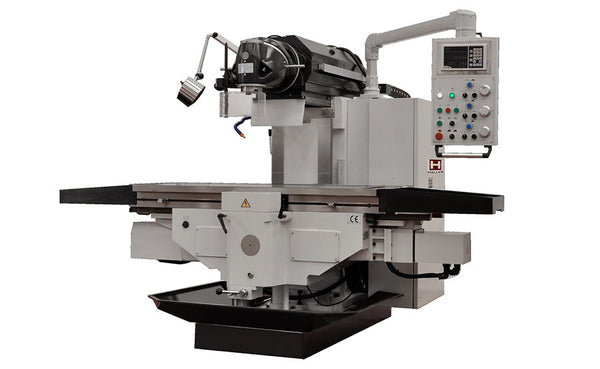


Looking for machinery for your workshop?
We will advise you with no obligation: a demonstration at our premises, commissioning and our own in-house service and support.