

Face and tangential milling: how they differ

In this article
Milling is a very common material machining process carried out through the rotation of the milling cutter; the cutter is the cutting tool made up of cutting edges or teeth and held in a head. Among the types of milling there are face milling, tangential milling, tangential conventional milling and tangential climb milling.
What is milling?
Milling is one of the most widely used methods of machining workpieces in recent times. This is due to the versatility of the process, which brings great benefits to the metalworking industry. Thanks to the milling machine, workpieces can be machined in a way that increases productivity and delivers results of high quality and accuracy.
Milling machines machine workpieces by metal cutting through the rotary movement of the milling cutter. In universal milling machines it is the workpiece that moves towards the cutting tool, rotating, to give the workpiece the desired shape. These machines can work all kinds of metals, including non-ferrous ones, as well as wood, steel and synthetic materials.
This type of machining allows the workpiece, once worked on the milling machine, to undergo another process such as roughing or sharpening. But how is milling actually carried out? How many different ways of milling are there?
Types of milling
Today many milling machines work through computer numerical control (CNC); that is, they are operated by a computer that executes the design previously prepared for the machine using special computer programs. Although CNC milling machines work thanks to a computer, the programming is still done by a human being. By this we mean that the milling movement is common to a CNC milling machine and a traditional one.
Knowing which type of milling best suits the workpiece depends on an analysis of the raw material that includes type of material, thickness, size, etc. This is determined by an operator experienced in the use of the milling machine.
Face milling
This type of milling, which is very common on vertical milling machines (where the spindle is vertical with respect to the floor), is distinguished by the use of a cylindrical helical cutter. This type of cutter uses a small number of teeth together with a large helix angle to produce a smooth, vibration-free cut with good finishes.
The helix angle means that the cutter can easily enter and leave the workpiece. In face milling the surface of the workpiece being machined is perpendicular to the cutter's axis of rotation.
In face milling, the cutter removes swarf of regular thickness using its peripheral or side edges, but finishes and profiles the workpiece with its front edges (hence the name); these front edges help improve the quality and final finish of the workpiece. One of the benefits of this type of milling is that the work is uniform and helps to optimise the performance of the machine and improve its power; undoubtedly a great advantage that helps keep production costs down. The cutters used in this process are called face mills.
Tangential milling
Tangential milling is also known as cylindrical or peripheral milling, and the cutters that carry out this type of machining are called tangential cutters. The machine tools on which this milling is usually carried out are horizontal milling machines; on these machines, the spindle that holds the cutter is parallel to the floor. In addition, the cutters used on this type of milling machine are characterised by being hollow so that they can be mounted on the spindle.
In tangential milling, the axis of rotation of the tool runs parallel to the surface of the workpiece to be machined. Swarf is produced by the peripheral teeth of the cutter: hence the name tangential.
Unlike face milling, in tangential milling the workload is uneven, since the swarf produced varies considerably in thickness and has a very particular shape. If the aim is to optimise the performance of the machine, it is most advisable to use a helical cutter. When carrying out this type of milling, it is very important to position the axis of the tool correctly: otherwise, the surface of the machined workpiece will have waviness.
There are two ways of carrying out tangential milling:
- In conventional (up-cut) milling, the tool rotates against the feed of the workpiece being machined. Here, the depth of the tool's passes over the surface means that the swarf produced is thicker, but the movement also produces vibrations on the machine. This can mean that the quality of the workpiece is not the best.
- Tangential climb milling occurs when the cutter rotates in the same direction as the workpiece. Because the cutting force in this type of milling is directed downwards, the machined workpiece is of higher quality, since the surface finish of the workpiece is improved.
Frequently asked questions
What is the difference between face milling and tangential milling?
In face milling the axis of the cutter is perpendicular to the surface of the workpiece, and in tangential milling it is parallel to it. Face milling is usual on vertical milling machines, removes swarf of regular thickness and gives uniform work; tangential milling, also called cylindrical or peripheral milling, is done mainly on horizontal milling machines, cuts with the peripheral teeth and has an irregular working load.
What is face milling?
It is milling in which the axis of rotation of the cutter is perpendicular to the machined surface. It is very common on vertical milling machines and uses cylindrical helical face mills, with few teeth and a large helix angle that gives a smooth, vibration-free cut. It removes the swarf with the peripheral cutting edges and finishes and profiles the workpiece with the face edges, hence its name.
What is the difference between up milling and climb milling?
They are the two ways of doing tangential milling. In up milling, the cutter rotates against the direction of feed of the workpiece: it removes thicker swarf, but produces vibration in the machine that can worsen quality. In climb milling, the cutter rotates in the same direction as the workpiece and the cutting force is directed downwards, so the surface finish is better.
How is waviness avoided in tangential milling?
By positioning the tool axis correctly: if it is not well placed, the machined surface is left with waviness. In addition, since in tangential milling the swarf varies greatly in thickness and the working load is irregular, it is advisable to use a helical cutter to optimise the machine's performance.
Keep reading
Articles →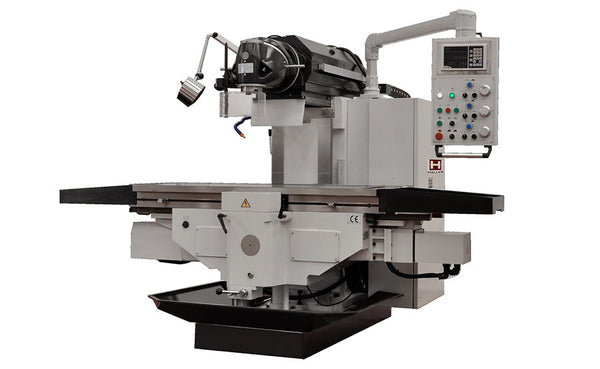


Looking for machinery for your workshop?
We will advise you with no obligation: a demonstration at our premises, commissioning and our own in-house service and support.