

Vertical Shaper or Slotting Machine

In this article
The vertical shaper or slotting machine, also sometimes called a vertical shaping machine, is a machine tool used for machining by slotting. This machining makes it possible to cut slots parallel to the cutting tool, but also to cut gear teeth.
What is a vertical shaper or slotting machine?
The vertical shaper or slotting machine is characterised by a reciprocating rectilinear movement that allows machining by swarf removal, when the cutting tool (single-point) approaches the surface of the part to be machined. The part remains fixed to the worktable by means of the various clamping systems, such as strap clamps.
This machine tool is used in machine shops to obtain slots parallel to the cutting tool, but it is also used to create the contours of cams, plates, levers, gears, keys, etc. The slotting machine is a machine tool that has stagnated, that has not adapted to new machining technologies, since the work done on it can be carried out on other machine tools such as the milling machine.
However, the vertical shaper or slotting machine has the advantage that it can handle larger parts to be machined than other machine tools that carry out these processes.
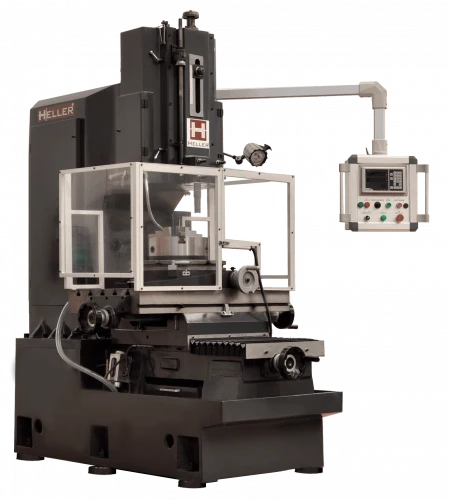
The slotting machine is made up of the following parts:
- Bed, fitted with the longitudinal carriage on which the cross carriage with a rotary table sits (depending on the machine).
- Column.
- Tool holder.
- Ram.
- Worktable.
- Gearbox.
Types of slotting machine
| Universal | The universal or ordinary slotting machine can have a fixed (vertical) or swivelling head (inclined slotting machine). The table of these slotting machines can be square or circular; if the table is circular, in addition to the movement of the two perpendicular axes, the table plate also rotates. |
| Punching machines | They are similar to universal or common slotting machines, but have greater power and accuracy in the work. |
| Gantry slotting machine | They are used for the machining of large parts. They are installed on a large table on which a gantry is placed, to which the tool holder is attached. The movement of this slotting machine is different, since the feed is achieved by means of the gantry. |
| Portable | These are slotting machines used for the machining of large parts that could not be worked on the other types of machine. |
| Modern slotting machines | Although slotting machines are machines that were never fully developed, because the work done on them can be carried out on other machines such as milling machines, it is important to point out that there are modern slotting machines fitted with a rotary table on the cross carriage that work by means of a worm drive and worm wheel. On these it is possible to carry out four types of slotting: contouring, circular slotting, dividing a part into equal parts and slotting in a single plane. |
The slotting process on the vertical shaper
The main characteristic of the slotting machine is its movement. This machine tool has a reciprocating vertical rectilinear feed movement and another idle return stroke over the parts to be machined, which remain fixed in the machine. These movements make it possible to work on flat surfaces parallel to the cutting direction of the single-point tool.
The vertical shaper or slotting machine is also characterised by the three movements it can perform:
- Cutting: performed by the tool or single-point tool and executed by following a longitudinal displacement on the vertical plane.
- Feed: this is the transverse or circular displacement followed by the part to be machined.
- Depth of cut: originates from the longitudinal and axial movement or displacement of the part.
The penetration movement or depth of cut can be obtained thanks to the positioning made between the part to be machined and the single-point tool. The penetration movement is achieved from the first pass, since it is work prior to swarf removal. However, once the part is fixed, the subsequent penetration movements (if several passes are required) will be achieved by displacing the part to be machined.
How does the vertical shaper or slotting machine work?
The vertical shaper or slotting machine has a basic operating principle by which electrical energy is converted into mechanical energy thanks to the action of the electric motor. The mechanical energy obtained passes through the gearbox, where the operator must regulate the speed. The gearbox then transmits this energy, through gears, to the machine spindle where the cutting tool is located. Depending on the work to be carried out, the movements of the slotting machine described above will occur. These movements serve to drive the single-point tool with a rectilinear, reciprocating movement; during the descent of the cutting tool, compression occurs and, when the tool begins the return stroke, swarf removal takes place.
Frequently asked questions
What is a slotting machine or vertical shaper?
It is a machine tool, also called a vertical shaper, that machines by slotting: the cutting tool or single-point tool moves with a reciprocating vertical straight-line motion and removes swarf from the workpiece, which is held fixed on the worktable by clamps or other clamping systems. It is used mainly to cut slots and gear teeth.
What is a slotting machine used for?
It is used to produce slots parallel to the cutting tool and to cut gear teeth. It is also used to create the contours of cams, plates, levers, gears and keys. Many of these jobs can be done on a milling machine, but the slotting machine has the advantage of accepting larger workpieces than other machines that perform these processes.
What types of slotting machine are there?
There is the universal or ordinary slotting machine, with a fixed (vertical) or swivelling head and with a square or circular table; the punching machines, similar but with more power and precision; the gantry slotting machine, for large parts, in which the feed is provided by the gantry; and portable ones, for parts that do not fit on other machines. Modern ones add a rotary table on the cross slide.
How does a slotting machine work?
The electric motor converts electrical energy into mechanical energy, which passes through the gearbox, where the operator sets the speed, and reaches the spindle that carries the tool by means of gears. This generates three movements: the cutting stroke, vertical and reciprocating, made by the tool; the feed, transverse or circular, made by the workpiece; and the depth of cut.
Keep reading
Articles →
Looking for machinery for your workshop?
We will advise you with no obligation: a demonstration at our premises, commissioning and our own in-house service and support.